

Latest
The Red Raiders traveled to Corsica last Saturday to take on the Jaguars of Corsica-Stickney. The game would start out in a seesaw affair, but the Raiders would catch fire from the perimeter and take a 22-12 lead into the second. Wagner would push their lead to 14 taking a 32-18 lead into half. Wagner would again increase the deficit for the Jaguars to 18 at the end of the third. Wagner would only mustard together 3 points in the fourth and come away with a 51-38 victory. The Raiders would go 18-45 from the field for 40 % while the Jaguars would be held to 31% 15-49. Wagner would shoot 7-8 from the line while Corsica-Stickney would go 7-14. The Raiders would commit 15 turnovers compared to 8 by Corsica-Stickney. Macy Koupal would record her first double-double scoring a game high 18 points and grabbing 12 boards, while also dishing out 4 assists. Emma Yost would also reach double figures with 11 points, grab 5 boards and dish out 4 assists. Ashlyn Koupal would add 9 points, grab 5 boards, get 4 blocks and dish out 2 assists off the bench. Shalayne Nagel would chip in 7 points, grab 6 boards, dish out 4 assists, and block 2 shots. Eve Zephier would round out the scoring for the Raiders with 6 points and grab 3 boards. “What can I say defensively! We did an excellent job of containing their scorers. Shalayne and Ashlyn held Broughton scoreless the first half. The rest of our defenders held their own as well as helped on Broughton when needed. It takes a team effort on defense to hold an offensive juggernaut to 38 points. We dominated the glass again 35-23. Offensively this might have been the best we have played all year. Unselfish, inside-outside ball movement, and great passes led to open looks and finishes. We need to do a better job of closing games out as we only scored three points in the 4th quarter. Just need to continue to play 4 solid quarters.
Read more
The Lady Raiders opened up the new year by traveling to Sioux Falls to take on the Sioux Falls Christian Chargers. Wagner would jump out to an early 21-13 lead. The Raiders would extend it to 37-22 going into the half. SFC would rattle the Raiders and hold them to 2 points in the first 10 minutes of the second half cutting the lead to 39-33 at the end of the third. Wagner would hold their composure and know down free throws to preserve the victory 50-40. The Raiders would start out hot from the field and then turn cold just as the change of weather on that day. They would end 15-46 for 33% while holding the Chargers to just 29% shooting 15-52. Wagner would hit 16-23 from the charity stripe while SFC would be 9-19. Wagner would get our rebounded for the first time this year 30-38. The Raiders would have 18 turnovers compared to SFC 16. Emma Yost would lead all scorers with another double-double recording 22 points and 12 boards. Lydia Yost would add 10 points off the bench. Shalayne Nagael would chip in 9 points, grab 3 boards, and come away with a game high 8 steals. Eve Zephier would net 3 points and dish out 2 assists. Macy Koupal would add 3 points, dish out 2 assists, and grab 9 boards. Ashlyn Koupal would round out the scoring with 3 points. “Offensively we got thing rolling in the first half. Hitting perimeter shots, moving the ball, and getting to the line. Defensively, we played a great game holding them to just 40 after they have been averaging 60 points a game. We didn’t do a very good job of rebounding on the defensive end that led to nearly half of their points on second chance points. We have to get that killer instinct and just end it when given the opportunity. They were a good team and fought back and stuck around for the long haul. We did get rattled but still held our composure to finish out the game on a high note!
Read moreWagner/Bon Homme Gymnasts competed at the Stanley County Gymnastics Invite January 8 to bring home third place.
Read moreThe 39th Annual Hanson Girls Corn Palace Classic will be held Saturday, January 15th. Come on out and cheer on the Thunder Ladies!
Read more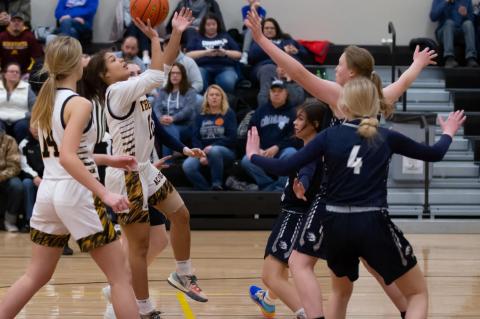
ACDC Thunder is off to great start as their season record now stands at 6-0. Come on out and cheer on the ladies as they continue their season. (Top Photo) Leah Brown attempts to get a shot off against a tough Burke defense. (Bottom Photo) Nadia Van Zuidam keeps her focus on the ball. More photos and story on page 6. Photos by Barb Pechous
Read more
Eugene "Gene" P. Payer, 85, died at Lake Andes Healthcare Center in Lake Andes Tuesday, January 4, 2022. Funeral service was Saturday, January 8 at St. Mark's Catholic Church in Lake Andes with burial following in St. Mark's Catholic Cemetery in Lake Andes.
Read more
Charles (Chuck) Leroy Denker, 87, passed away in his sleep at his Roseville, California residence with family members by his side on December 16, 2021. Charles was born in Wagner on February 11, 1934. He was the son of Fred and Helen (Teibel) Denker.
Read more