

WHERE ARE THE AMIDONS?
WHERE ARE THE AMIDONS?
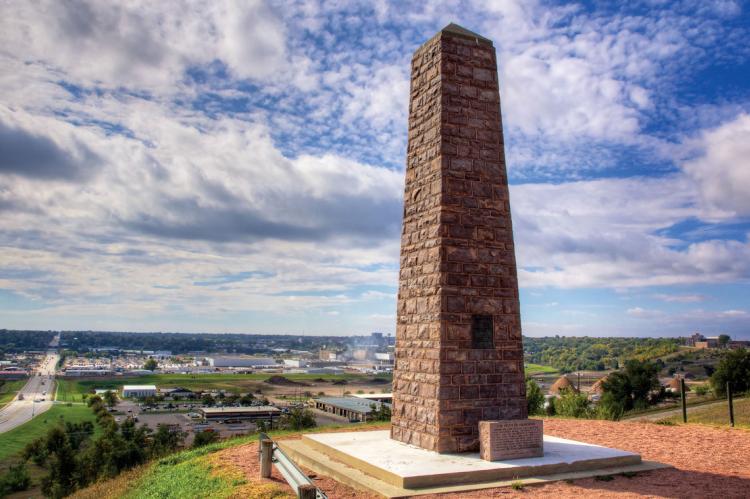
High atop a bluff along busy Cliff Avenue in northern Sioux Falls stands the Pioneer Memorial, a tall quartzite obelisk built to honor the area’s first homesteaders. Visit today and you can see more than a century and a half of progress in every direction. Plumes of steam shoot from the stacks of the Smithfield plant at the base of the hill. Handsome pink quartzite buildings that comprise the state penitentiary sit to the west. Cars whiz past on Cliff and Interstate 229 just a bit farther east.
But 162 years ago this was a quiet hayfield, and no more than a few hundred people lived in Minnehaha County. It’s where Judge Joseph B. Amidon and his son William were working on Aug. 25, 1862 when gunshots pierced the air. The judge and his son were found dead nearby the next day. It was quickly deduced that Indians killed the Amidons, and they were laid to rest. But anyone wishing to pay respects will have no luck finding them in any local cemetery. The Amidons have gone missing.
The Amidon mystery long intrigued Bruce Blake, a Sioux Falls lawyer who helped place more than 200 historical markers around Minnehaha County, including the original marker commemorating the Amidons in 1991. He pieced together the family’s story through documents gathered from Amidon descendants.
The Amidons arrived in the village of Sioux Falls in 1858. Joseph worked as a stonecutter and later became a judge, treasurer and commissioner under the newly formed Dakota Territorial government.
He and William left to cut hay on William’s homestead about a mile away on that August morning in 1862, but they had not returned by nightfall. Joseph’s wife Mahala sought help from Company A of the Dakota Cavalry, stationed in Sioux Falls to help quell violence between settlers and Indigenous people. They found Joseph and William lying dead in a cornfield. William had nearly a dozen arrow wounds. A gunshot killed his father.
The family Bible noted that they were buried on August 27, but their gravesites have been lost to history. For many years, local historians believed they were buried not far from where they died. In 1927, the Minnehaha County Historical Society marked what it believed was the spot with a quartzite post. But Blake wanted to be sure. In 1991 he convinced the society to hire Augustana University archaeologist Adrien Hannus to excavate the area. Soil samples revealed only decades worth of trash discarded by local farmers.
Blake continued his research and found accounts of burials in at least two other locations within Sioux Falls, but further excavations and records searches also turned up empty. He died in 2017, the answer to the Amidon mystery still as elusive as ever.
Perhaps that answer lies in a faded slip of paper in someone’s attic, a misplaced cemetery record or a bundle of correspondence boxed away in the city’s archives. But until it surfaces, South Dakotans can honor the Amidons — and the hardy homesteaders who helped tame Dakota — atop that hill on the edge of Sioux Falls.
John Andrews is the editor of South Dakota Magazine, a bi-monthly publication that explores the people and places of our great state. For more information, visit www.southdakotamagazine. com.