
STUDENTS GET A BITE OF REALITY
STUDENTS GET A BITE OF REALITY
Alyssa Mathis
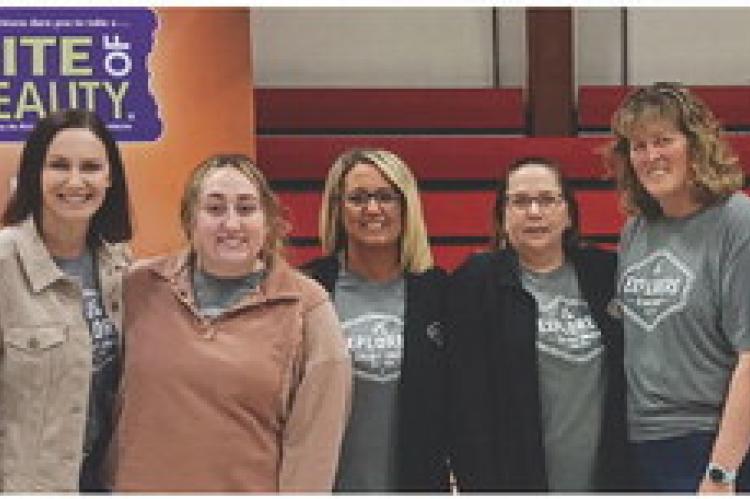
Explorers Credit Union of Yankton teamed up with the South Dakota Department of Labor to bring the Bite of Reality Simulation to the high school students of Avon. The event took place at the Avon gymnasium on Wednesday, May 1, from 10 a.m. until 11:30 p.m. Avon Chamber of Commerce members, Deb Voigt and Nyla Raysby, scheduled 14 community volunteers to assist with the simulation.
The Bite of Reality program is a hands-on, app-based simulation that gives teens and young adults a taste of real-world financial situations. Upon opening the app, participants are given a fictional persona which includes an occupation, salary, credit score, possible spouse, a possible child or children, debt and medical payments. The app gives them their available wages for the month to work with. The wages were based on real occupations with some of the jobs the Avon students received being a social media influencer, interpreter, newspaper editor, architect, mechanic, etc. Then each student stops at all eight of the available merchants to make digital purchases on their app. The merchants include housing; groceries and dining; entertainment; child care; household needs; transportation; clothing and personal care; and shopping. If the student gets into a bind, then the credit union is on hand to help counsel them on their decisions and coach them to make better purchases to meet their budgeting needs.
It is hoped that this interactive activity will teach young adults how to make financial decisions and give them a better understanding of the challenges of adulting and living on a budget. When visiting the numerous merchants in the simulation, the volunteers were encouraged to be “pushy” and try to get the students to purchase the most expensive options. This was in hopes that the students would stop and consider their wants versus their needs. During each student’s shopping trip, a “Fickle Finger of Fate” would appear on the screen which would give the students unexpected life expenses and windfalls, similar to how it usually happens in real life. Examples of “Fickle Finger of Fate” scenarios that the Avon students encountered were birthday gifts, having a hacked bank account and losing $360.
For example, at the child care table, formula ($160 a month/ child) and diapers ($150 a month/child) were automatically deducted from the student’s budget depending on the age of their child or children. Then the students were expected to choose between day care provided by either a licensed day care provider for $1080 a month per child or child care provided by grandma or another family member for $360 a month. The next choice for the student was with children’s clothing. The options included $60 for designer clothing; $36 for department store clothing; $12 for discount store clothes and free for handme-downs. The final choice at the table would be presents, books and toys. Their choices were $36 for brand name supplies; $24 for department store supplies; $12 for discount/sale supplies; and $6 for second hand supplies.
After all the students had completed the simulation, Julie Fleek from the SD Department of Labor and Regulation and Explorers Credit Union CEO, April Tompkins, then debriefed the students about their experiences. This was only the second time that the two organizations had done this type of simulation; the first being at the Bon Homme School District. The ladies asked for a show of hands of how many students were not able to survive on their income with several raising their hands. One of the biggest troubles that the students got into would be when they visit the transportation table and buy vehicles for themselves and or their spouses. It is very rare that the students pick to buy used vehicles as opposed to brand new. The students seemed to grasp how important having a good credit score is when it comes to being able to make big purchase items such as homes and vehicles. Each student’s scenario started and ended differently. Most of the students in the simulation each had one child and a spouse. $998 was the highest amount that a student had left over after making all of their monthly purchases, while most students were left with a zero-dollar balance at the end of the monthly bills.
One interesting occurrence that happened several times would have been where a student would purchase themselves a vehicle and then buy their spouse a bus pass. For app improvements, the students suggested having scenarios without kids which is something that will be a reality for most of the students sooner in their lives. They also suggested having more options when it came to their purchases giving the students occupations with higher salaries.
When asked what the students learned from the simulation, their responses were that they definitely learned something and taking part in this exercise really made them think. Julie and April suggested to the students that when it comes to their futures and careers, they should look at careers/jobs with salaries that will meet their lifestyle needs.
After the simulation there were three students that shared their experiences. The three students were McKenna Kocmich, Landon Thury and Ashley Tolsma. McKenna’s persona was a social worker who made $2500/month and was married with her husband earning $2200/month. Landon’s persona was employed as a newspaper editor who made $2800/month and was married with his wife earning $2200/month. Ashley’s persona worked as an Assistant Financial Advisor making $3,000/month and her persona’s husband worked as a carpet layer making $2200/month. McKenna’s simulation experience went smoothly and after all monthly expenses she still had $850 in her bank account. She was also able to buy both her and her husband vehicles. Landon’s experience for the most part went well and after all monthly expenses were deducted, he had $150 still available. Landon was also able to purchase both he and his wife vehicles. Ashley’s simulation experience was more realistic. Even though her combined income was higher, after paying all her monthly bills, Ashley was left with $167 in outstanding credit card debt. This was after choosing the cheapest options when it came to all of the necessities that had to be purchased. When it came to transportation, Ashley was able to purchase one vehicle and a bus pass for her and her husband to be able to get to and from work.
After all was said and done, it was a great experience and opened the eyes of many students to just how costly life can be and the importance of financial education. Community volunteers that helped run the merchant tables included Sandy Cihak Brandt, Ilene Muller, Caitlyn M from Avon Community Bank, Lisa Einrem, Carol Eggers, Bonnie Meiers and Heidi Sedlacek from RushCo, Mike Muller, Amy Yost, Alyssa Mathis from Pechous Publications, and Jerry Fink. The Explorers Credit Union staff that were on hand to financially assist students through the stimulation were April Tompkins, Taylor Tindle, Monica Dahl, Shannon Wiebenga and Jen Rucktaeschel. Thank you to all the Avon school staff, Explorers Credit Union, SD Department of Labor and the community volunteers for making this a successful learning event for the Avon high school students.