
Rotary News
Rotary News
Dear Readers, there have been some technical issues as well as miscommunication in the past month with the Rotary articles being published. Please accept our apologies for these issues and we hope you will continue to read about our Rotary Club.
The February 21st meeting of the Wagner Rotary was called to order at high noon by President Becky Brunsing. Pastor/Rotarian Bill Heermann gave thanks for the beautiful warm weather we were experiencing and asked for guidance for all Rotary members in learning about the needs of our Wagner Community.
Guests for the day were Connie Steele, mother of Rotarian Amanda Bechen and Mike Kirwan the father of Ed Kirwan who happened to be giving the program for the day.
Song leader Jeff Doom chose the easiest song in our music book SMILE which we sang with gusto!
Rotarian Ken Cotton gave the Membership Minute, and he spoke about Interact. Interact clubs give young people 12 to 18 years old the chance to work together and have fun while learning about service and promoting international understanding. Each club is required to complete at least two major projects each year, one to serve the community and the other to promote international understanding. Interact clubs are sponsored by nearby Rotary clubs and may be co-sponsored by Rotaract clubs. Ask a Rotarian how you can get involved.
Rotary Youth exchange promotes international understanding and lifelong friendships by letting young people explore another culture. Exchanges can be long-term, or short-term. Short-term exchanges last from a few days to several months and often take place when school is not in session. Students typically stay with a local family in the host country, but they might also attend a youth camp or tour the country with other foreign students During a long-term exchange, students spend a year in another country, attending school and living with host families. Exchanges vary widely among districts, so contact your district’s Rotary Youth Exchange chairperson to learn what is available in your area.
Sergeant at Arms Jamie Soukup levied the following fines: $2 to Jeff Doom for his conversation bashing Canada; $2 to Bill Frei for having all his cattle out; $2 to Craig Krsnak for missing the meeting and the great German Chocolate dessert with coconut in it. Happy Fines came from Jerry Weber: $2 for being able to hear the fines without Slaba’s furnace running; $ 4 from Amanda for the four Rotarians having a meal with their parent for the day; $2 from Kathe Henke for being a Rotarian for twenty-nine years to the day! Congratulations Kathe!
President Brunsing held the winning ticket number but only found the Two of Spades. There are less than twenty-five cards left now in the deck. The prize money is up to $455. The attendance race just keeps widening. The Juffer Team has twelve misses, and the Frei Team has six misses.
Other business items were a check being presented by Bill Frei for the load of cans that were taken to Mitchell this past week. Cans are .30 a pound right now.
President Brunsing announced that one member of the Wagner Community presented their application for joining the Australian Team from District #5610 to go to Australia next year. Wagner’s Rotarian Gerrit Juffer will be serving on the Selection Committee for District 5610 and there are a total of sixteen applicants that are willing to go to Australia next year.
Rotarian Rachel Woods spoke about an offer from Mike Pettit of Access Granted that he has made to businesses in Wagner. He will put up a security camera for anyone and they must only pay for the camera and the installation of electricity. There will be no monthly fees assessed and Woods thought it would be beneficial to all if a camera were installed on the East side of the Rotary Building. All members were in favor of the suggestion.
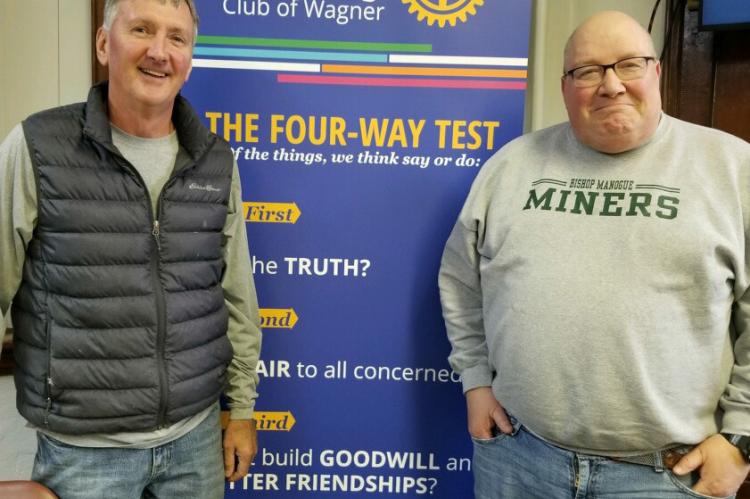
Rotarian Doom introduced his program speaker, Ed Kirwan who has been in the mining business most of his professional career. Ed has spoken to our Rotary Club in the past and always has valuable information. The topic for his presentation was Mining Life Cycle, what is it? He started out by explaining the diverse types of mine ownership: State, Federal, which can be Patented or unpatented. If you are making a claim for a mine your first job is to obtain a geologist that can map out your claim. It is then explored by drilling, which is extremely expensive to find out if it is even feasible to try to mine an area or to just keep the area put it in reserve.
The next step is to present samples to investors and get approval by the government. There are four kinds of investors, private, equity, or hybrid commercial investors. He explained the difference between the investors and mentioned that they get a substantial percentage of the rates which are very restrictive. He also listed the different permits that must be obtained from the government which includes all kinds of permits from State, local, and federal governments where the proposed mining site is located. Environmental concerns are a big issue when it comes to permitting. Green practices have a lot of requirements for mining. Ed mentioned one mine that took fifteen years to get permitted.
Once permitting is obtained then operational costs enter in. Mining equipment is extremely expensive; with machinery costs being in the millions per construction machine.
The last item to be addressed is when the mine has been depleted and according to all environmental regulations the tailings (waste) and other debris must be cleaned thoroughly, and the land returned to its original state.
The club adjourned in its usual fashion by reciting the Four-Way Test.