
Rotary News
President Rachel Woods called the meeting to order on Wednesday, June 21st with a full body of Rotarians gathered for the day. There was one guest, Daydra Zeislar, who is a summer intern at Juffer, Inc. Woods gave a prayer of thanks for the rain we were receiving now, all in attendance, and a special request to hold Pastor/Rotarian Bill Heerman and his family close as they go through the grieving process for Pastor Bill’s mother.
Song leader Gerrit Juffer picked a good song, Red River Valley and the accompaniment on his Bluetooth was excellent. We all enjoyed singing this one.
Rotarian Ken Cotton gave the Membership Minute on Rotary Firsts and The Classification Principle. All membership in Rotary is based on a “classification” in accordance with a member’s business profession or type of community service. These classifications are determined by activities or services to society rather than the position held by a particular individual. The classification principle is a necessary concept in ensuring that each Rotary club represents a cross-section of the business and professional service of the community.
Sergeant at Arms Jordan Weber’s job of fining Rotarians each week is coming to a close also so he worked diligently to have a long list of fines: $2 each to Joe, Kathe, Linda, Ken and Rachel for getting their dessert first instead of later; $5 to Jeff Doom for driving his tractor down the highway on Monday and smiling and talking on his phone all the way; $1 to Joe Stedronsky for his poor fishing trip; $3 to Jerry Weber for his progress in constructing a basketball court after eight years of planning; $2 to Amanda Bechen for her new loud pants and $2 for sitting at a “Lake Andes” table; $2 to Jamie and Jerry for talking about the upcoming program; $2 to Rachel and Bill; $2 to Gerrit for such a good song. Happy Fines came from Joe Stedronsky of $7 for having seven grandchildren and they are all boys; Jerry Henke gave $5 for such a good 605 Unity Jam; $1 from Gerrit Juffer for his middle daughter getting engaged, and $5 from Becky Brunsing for her middle daughter getting married this coming Saturday.
Brunsing also won another chance at the Queen of Hearts drawing and this time pulled the 2 of Spades which would have been worth $118.00.
The attendance race is holding for another week with Jamie Soukup’s team having 11 misses and Jordan Weber’s team having 12 misses.
The date for the Roger Wiltz family to come to Wagner will be July 15th. They will be at the Rotary Shelter receiving guests. Watch the newspaper for times.
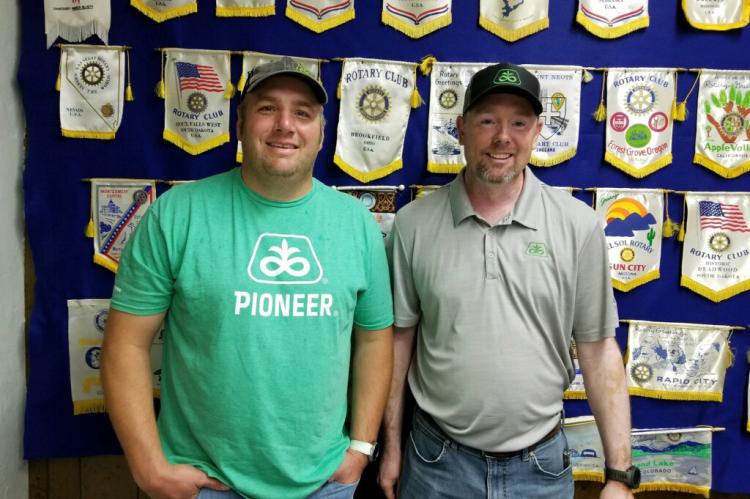
Rotarian Jamie Soukup introduced his program, Jerrod Ralston who is an agronomist for Pioneer Seed. Jerrod grew up on a farm six miles west of Lake Andes and graduated from LA High School in 1996. He attended SDSU for Wildlife Management but later switched to Agronomy and graduated in the fall of 2000. He had done an internship for Jerry Weber in the summers between classes and Jerry Weber hired Jerrod to be an Agronomist for the Wagner Coop. In 2013 Jerrod went to Armour and worked for Kevin Leonard who is also a Pioneer dealer. He then spent one year working in Tribal Relations; and then Jerrod went to work for Pioneer as a Field Agronomist. He covers several counties and travels all the way from Parkston to Platte, and back to Wagner.
Ralston summarized his seasonal work: In the spring they plant test plots of beans and corn and periodically visit those plots to record test results. In the summer he spends time doing service calls for farmers who have questions about bugs, spraying, crop progress, weeds etc. In August they spend time at Dakota Fest and harvest usually starts by the end of August. In November and December the sales representatives start ordering their seed for customers.
Jerrod gave some little-known facts about the three major seed companies: Pioneer, Syngenta and Dekalb. Syngenta is owned by China and Dekalb is owned by Germany. Pioneer is the only United States seed company!
Ralston was asked how many hybrid varieties he has. He replied about 69 in corn and approximately 125 or 126 in soybeans. Pioneer also sells canola, sunflowers, milo, and soft red winter wheat. Agronomists periodically go to Des Moines for research and development information. There is a twenty-acre greenhouse in that location, and he also attends meetings in the winter regarding their products.
Pioneer has seed production plants in the US, Hawaii, and Chile. Pioneer works under Corteva, Dupont, and Dow with chemicals. Soukup was asked how many varieties he has on hand, and he reported about ten to 12 varieties and his silo is full of soybeans. He needs to keep a bulk of those on hand as the seed is smaller and it takes more seeds per acre than corn. He keeps about 7 or 8 varieties on hand.
Ralston said Pioneer is constantly working to improve and farming practices have also improved which has raised the cost and the profit for the farmers.