

REAL LIFE BAND OF BROTHERS
REAL LIFE BAND OF BROTHERS
Alyssa Mathis
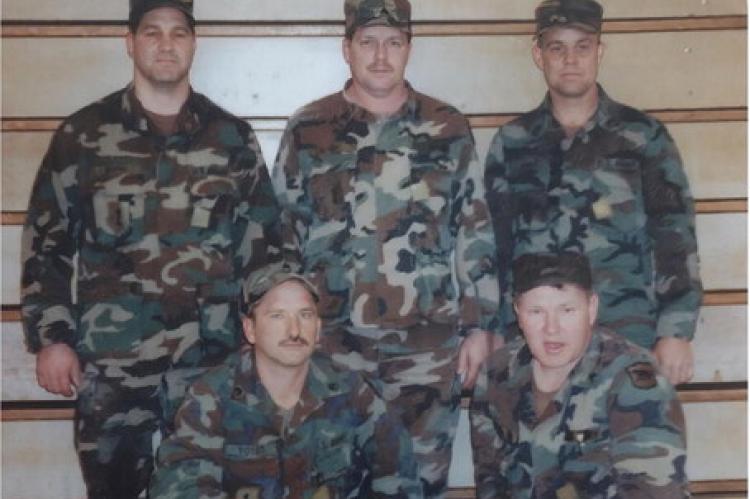
Much like the HBO miniseries, “Band of Brothers” depicting the lives of a company of soldiers and their experiences during WWII, there are five local men that grew up in the Avon area that became a band of brothers. Virgil Cihak, LeWayne Lukkes, Bruce Voigt, Roland Luke and Melvin Mudder joined the military, some starting out in different branches, but all ending up serving in the Springfield National Guard Unit. Springfield had a National Guard unit from 1956 until 1994. Late 1993 into early 1994, the entire state had a National Guard reorganization, where their battalion (the 153rd) went from four companies to three companies, eliminating Springfield which was a D company. With the Springfield unit closing its doors in January of 1994, the five soldiers evaluated their time with the National Guard three of the five men ending their service. LeWayne and Melvin decided to continue their service and joined the Wagner National Guard Unit. When all five of the fellow soldiers’ time serving in the National Guard is added up, it equals 125 years. These five men not only served their country together but formed a bond that went past being just being soldiers, friends or classmates; they became like family. In June of 1973 at the young age of 17, Bruce Voigt, Melvin Mudder and Roland Luke joined the National Guard. Melvin’s older brother was on leave from his own military service with the National Guard and talked the three young men into joining. Melvin’s brother stressed the benefits that the three could enjoy if they joined the service. He told them that if they joined that they would be given free health insurance when they turned 60 years of age which to three 17-year-olds that did not know much about health insurance it sounded like an amazing benefit. It was easy for the three to join together as they had grown up together and were already good friends. LeWayne enlisted in December of 1976 with the Marines. He joined the infantry. In August of 1974, after just turning 18, Virgil decided that he wanted to serve his country as well and joined the Army where he was active duty for three years. For Virgil deciding to go into the military was an easy decision. His father had been in the Army, at least three of his friends were already enlisted in military service and he did not want to attend college after graduation. For basic training, Virgil attended Fort Leonard Wood in Missouri which is a U.S. Army training installation that is located in the Missouri Ozarks. He also completed his Advanced Individual Training (AIT) there as well as a mechanic. Some of the highlights from this part of Virgil’s service were traveling to Germany twice while in the Army as well as being stationed at Fort Irwin in California. After his three years in the Army, Virgil decided that he wanted to continue serving his country, but wanted to do it locally in South Dakota. He joined the National Guard Unit in Springfield in 1977 and spent the next 25 years serving in the Springfield unit. His AIT in the National Guard was as a combat engineer. As a combat engineer, Virgil was expected to construct fighting positions, be able to prime and detonate explosives and become an expert in general engineering. Two of the most memorable experiences for Virgil during his National Guard service were when there was flooding in Rapid City and the unit helped build bridges and the unit’s two weeks in Panama. LeWayne decided to join the Marines in the infantry division. As a member of a Marine’s infantry unit, LeWayne was trained in ground forces to locate and destroy any enemy through fire and maneuver or to repel their assault by fire and close combat. As a Marine, one of the highlights of his service would be his tour overseas. LeWayne served his four years in the Marines before being discharged and coming back to the Avon area. Once out of the Marines, LeWayne decided that he really enjoyed serving his country and wanted to continue from the comfort of the local area. It helped that he already had four friends that were a part of the Springfield National Guard Unit as well as relatives that were encouraging him to join the unit. LeWayne did not have to take any more basic training or AIT as he had just gotten out of the Marines and was grandfathered in. In total, LeWayne served 30 years with the National Guard which included being a part of both the Springfield and Wagner units. As a part of Wagner’s 153rd Engineer Battalion he was deployed to Iraq in 2004. He was the only one of the five that was a part of the Operation Iraqi Freedom II. As a part of that deployment, LeWayne was the squad leader for the unit. One of the highlights of his service with the Springfield National Guard Unit was when the unit was called out to help clean up after a big storm hit Tyndall. Bruce, being one of the three to join the Springfield National Guard Unit as a senior in high school served just shy of 21 years in the National Guard. He attended basic training at Fort Leonard Wood, Missouri where he also did his AIT as a heavy equipment operator. One of the highlights of his service was the two weeks that the unit was deployed to Panama. After his experience in Panama seeing the locals drive motorcycles, riding horses for transportation, living in bamboo huts and washing their clothes in the river, it definitely made Bruce appreciate coming home and feeling blessed to live in the United States. Another highlight from Bruce’s years of service would be getting to serve his country alongside his four fellow classmates that were friends turned soldiers. Roland joined the Springfield National Guard Unit as he felt it was a step in the right direction. He also did his basic training and AIT at Fort Leonard Wood, Missouri with his AIT being in heavy equipment operations, primarily operating a bull dozer. Roland spent a little over 20 years as a member of the Springfield National Guard Unit. One of the biggest experiences from his days in the military that one can only get by being a member of the military is the way that soldiers are trained to respect authority, taught discipline, and taught to respect others and look out for one another. For Roland, highlights of his service were the friendships that he made, the ethics learned and the experiences that he had. Melvin was first talked into joining the National Guards by his brother that was two years older than he was. Like the other three that joined the Springfield National Guard Unit together, he also did his basic training and AIT at Fort Leonard Wood, MO. Melvin originally began his National Guard work as a heavy equipment operator, but later changed to a culinary specialist better known as a cook. Melvin was in the National Guard for 28 years. Just as LeWayne had joined the Wagner National Guard Unit after the Springfield Unit was disbanded, Melvin did as well. He decided to end his service with the National Guard before the Wagner unit was deployed to Iraq. One of the neat experiences that four of the five men shared was that while the Melvin, Bruce and Roland were attending basic training in Fort Leonard Wood, Virgil was stationed at Fort Leonard Wood. Virgil had a car while he was stationed there. He would come and pick up his three friends and the four would spend time together and saw each other often. Since the age of five, Melvin, LeWayne and Bruce had grown up together attending the same church. Melvin and Bruce were close as they had grown up about a mile apart and spent time together as part of their church, as softball teammates, as classmates and eventually as soldiers. Virgil joined the class in junior high and Roland became a part of the crew in high school. Coming from a class of 35, having these five men all wear uniforms and be a part of the same National Guard Unit was a pretty amazing experience. When all five were asked about highlights of their service in the National Guard Unit, they all to some extent said that the comradery that was built as well as their monthly service duty feeling like a once-a-month reunion. As with most things in life, when the men ended their service, they did not get to see each other and did not necessarily keep in touch as well as they would have liked. One thing is for certain though, the comradery that these five men built while serving the country out of the Springfield National Guard Unit will always be a part of their life and a great experience that they all look back on with fond memories. Of the five, they are missing one. Melvin unfortunately passed away before the age of 60. As one of Melvin’s best friends, Bruce had this to say about him. Melvin was a great man, very well liked, hardworking and was one of the most helpful soldiers in the unit. He would do anything that he could to help others out. Roland shared the same sentiment as he and Melvin worked in the kitchen together. All five of them enjoyed their time in the service and the comradery that they built together. Virgil summed it up best when asked if he had anything to say to his fellow four classmates and friends, turned soldiers, “It was an honor”.