
OUTDOOR CLASSROOM AT WALKES FARM
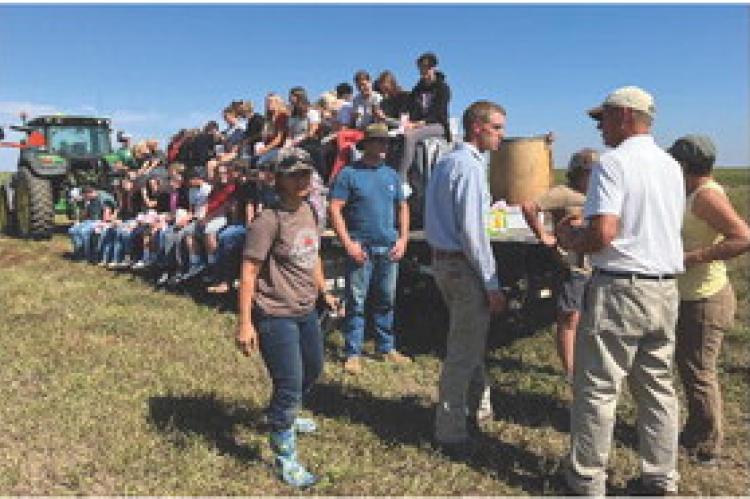
What did pioneer and native populations do when they suffered from toothaches? Or rashes or tummy problems? Avon Science students and Bon Homme Natural Resources students could help you find the plant or plant part that might provide some relief after attending the Dave and Mary Walkes Outdoor Classroom September 20.
Shane Delanreau from South Central Watershed Project, led the students through the diverse forbs and grasses growing synergistically in their perennial pasture ground. He explained how humans learn to use these medicinal plants, but livestock instinctively gravitate to them when they need their medicinal powers. For example, cattle or sheep may eat wormwood when parasites are a problem, or plants high in tannins, i.e. grape leaves, when they have imbibed on forage causing bloat. That is just one of the many reasons a pasture with diverse plants promotes improved health of the animals.
Sheep are now the third species on the pasture. They move as a combined group with the cattle, forming a flerd. Both cattle and sheep browse leaves on the trees and shrubs. Cattle prefer grasses and legumes; sheep eat a multitude of forbs in addition to grasses.Chickens are omnivores. They supplement their grains with all green forage and get their protein primarily from insects.
Forbs, frequently called weeds, are the intended casualty of most sprays. Because each species prefers different forages, more meat can be produced per acre by combining species. Surprisingly, graziers such as Jim Gerrish contends an equal number of sheep can be grazed simultaneously with cattle on the same amount of land that would feed the cattle alone. The flerd is rotated daily or every few days, as forage indicates. Animals are eager to move. Very quickly they learn that each move gives them fresh forage.
Some of the laying hens were caught, snuggled and even named! The hens are the “pest containment unit” in the multi-species grazing operation. Chickens are moved weekly in the trailer to follow the cattle. After 4-5 days where the dung beetles have transferred nutrients from the patties into the soil, the hens find yummy and nutritious maggots (fly larva) to give them a high protein snack. Every maggot eaten by a chicken is one less fly the cows have to deal with. A grasshopper is ‘steak’ for chickens!
Dean and Candice Lockner provided a mini ‘TED Talk’ about Regenerative Agriculture and Natural Life Principles. Although the threatened rain forests have been touted as an impending disaster for years in news reports, it was news to most of us that grasslands are the most threatened ecosystem in the world! The Lockners discussed the five processes that promote soil health: 1) Armour on the soil, 2) Minimal tillage or disturbance, 3) Plant diversity, 4) Living roots in the soil as much as the weather permits (perennial forages), and 5) Animals on the soil. Each one of these concepts, as they are incorporated, helps improve soil health and subsequently, production.
To learn more about stacking enterprises with multi-species grazing, contact your local NRCS agency, South Dakota Grassland Coalition, and the South Dakota Soil Health Coalition.
Click here for a video of last year’s event done by the SD Grassland Coalition. https://youtu.be/VTvxxDzlJIc?si=PYELzHY_k9UfxFWL
Click here for a photo of the endangered grasslands. https://conbio.onlinelibrary.wiley.com/cms/asset/f23f063d-1a03-4102-91e9-13fe4b09cfe5/csp2626-fig-0002-m.jpg
US Grasslands Map: https://www.fws.gov/media/assessmentmappng
Details: https://www.fws.gov/press-re-lease/2022-12/central-grasslands-assessment-mapnew-tool-ensure-future-our-grasslands
Central Grasslands Roadmap: https://static1.squarespace.com/static/5e600ddcde3d9a12661c36a7/t/6387e19f063a7831b-c879d9f/1669849503477/Assessment+Map.pdf
From https://static1.squarespace.com/static/5e600 ddcde3d9a12661c36a7/t/62b0 e24024 c95f0651d1b59c/1655759428265/The+Central+Grasslands+Roadmap_Summit+Update_6_20_22.pdf