

LATE SUMMER ADVENTURES
LATE SUMMER ADVENTURES
The days are getting shorter. Families are already checking back-to-school shopping lists. And did I see an aisle of Christmas lights at Menards last weekend? No, that must have been a nightmare. Still, it seems summer is quickly slipping away, so let’s get outside and enjoy the great South Dakota outdoors while we can. Here are a few ideas, gleaned from our March/April 2023 South Dakota Magazine feature on outdoor adventures and selected with late summer in mind.
Tag a Monarch
Tagging monarch butterflies helps us learn about their incredible lives. A butterfly typically hatches here in August, and then as autumn arrives it flies 2,500 miles southward to the Oyamel fir forests where it hibernates through the winter. When it reawakens and flies north in the spring it lays eggs, which dramatically shortens its lifespan. Soon it dies. The process repeats itself as the butterflies travel northward. Monarchs that arrive in South Dakota around Mother’s Day are the fourth-generation descendants of those that departed the previous fall. Look for tagging events around the state; Good Earth State Park has one planned for August 24.
Find a Fairburn Agate
South Dakota is heaven for rockhounds, and the Fairburn agate is prized. The state’s official gemstone was first hunted in the Kern agate beds east of Fairburn in Custer County, but it can also be found in Teepee Canyon west of Custer and elsewhere West River. People have even discovered them mixed with landscape rock and fill material taken from pits near the Cheyenne River. Serious rock hunters have spent days and even weeks searching for Fairburns with no luck, so consider yourself fortunate if you spot even one.
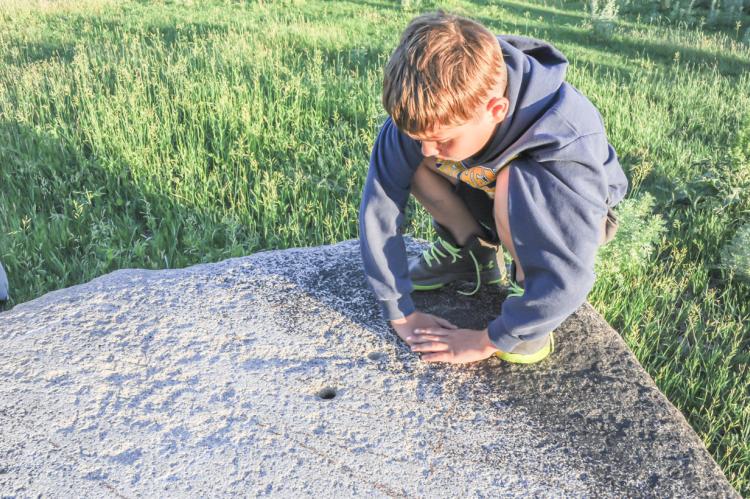
Ponder the Holey Rocks One of South Dakota’s great and unresolved mysteries is the “holey rocks” of Roberts County. All of northeast South Dakota is rocky, thanks to glaciers that brought the rocks here 10,000-plus years ago. Some of the biggest boulders have holes about as wide as a quarter. A geologic detective documented 57 such stones, though there are probably many more. One theory is that the stone holes were chiseled as guideposts by Viking explorers who traveled here from Hudson Bay in medieval times.
Get a Heavenly Forestburg Melon
“When one has tasted watermelons, one knows what angels eat,” said Mark Twain. Imagine what he would have said if he’d known about Forestburg. The sandy soil of the James River valley provides the perfect growing environment for watermelons and muskmelons, and they typically ripen in August. If you don’t live in Sanborn County, keep an eye out for roadside stands.
South Dakota has less light pollution than most states, so we should all be amateur stargazers. Badlands National Park is the most enchanting place to watch the stars; park officials offer a Night Sky Program on weekend evenings through the summer. However, rural areas across the state — even in more populated East River — are conducive to seeing the Milky Way and other mysteries of the heavens.
Spot the Dipper
Have you ever seen a slate-colored bird that could walk under water? If so, were you afraid to tell anybody? Relax. You weren’t seeing things. It was the American Dipper, famous for its ability to catch food by swimming underwater or walking along stream bottoms. Find them in Spearfish and Whitewood creeks in the northern Black Hills.
Pick Chokecherries
A moon of the Lakota calendar is called Canpasapa-wi, “the moon when chokecherries are ripe.” That’s typically August in much of South Dakota. Farm herbicides seem to have decreased the number of wild bushes in East River, though they can still be found in most counties. Chokecherries also grow west of the Missouri and in the Black Hills. Find a bush and start picking. Don’t just take plump purple berries; pluck a few light red and green ones as well because they add even more flavor.
John Andrews is the editor of South Dakota Magazine, a bi-monthly publication that explores the people and places of our great state. For more information, visit www.southdakotamagazine. com.