
THE LAKE ANDES NATIONAL WILDLIFE REFUGE
THE LAKE ANDES NATIONAL WILDLIFE REFUGE
Alyssa Mathis
Northeast rural Lake Andes is home to a unique landscape that is a mixture of grasslands and wetlands. This picturesque setting is home to the Lake Andes National Wildlife Refuge. The refuge is comprised of 5,639 acres of refuge land and 4,700 acres of lake. It was first created when President Franklin Roosevelt signed a Presidential Executive Order in 1936 which allowed for the purchase of the first 365 acres of land in the Owen’s Bay Area.
Lake Andes flooded in 2019, creating a devastating loss to the refuge’s visitor center and the Owens Bay Nature Trail. The Owens Bay Trail had been washed away and damaged and was in need of repair. Until recently the visitor’s center was surrounded by damaged and dying trees and the center itself had remained a dilapidated, crumbling building that had such extensive damage it was not able to be used by the Lake Andes Wildlife Refuge office staff. The building was in such disrepair that in July of 2019 the administrative staff had to move into a temporary office space in Pickstown and has been there ever since. Luckily, the maintenance shop was far enough away that it was unaffected by the floods and was able to continue to be utilized.
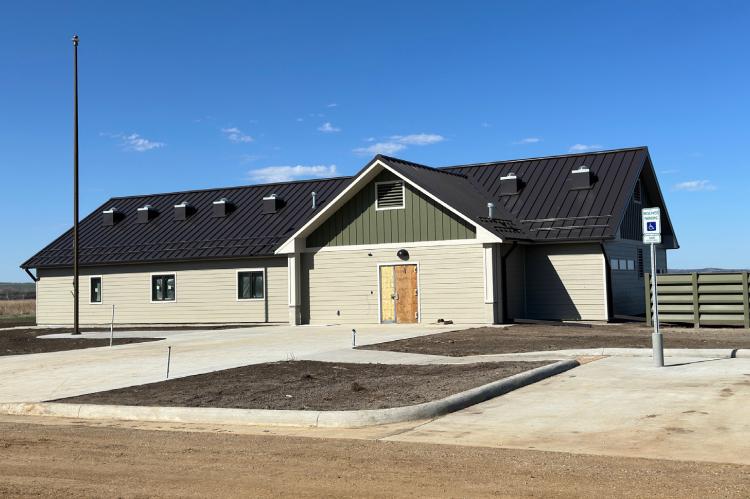
Construction began on the Owens Bay Trail in 2023 to fix and improve the one main trail of the Lake Andes National Wildlife Refuge. When all of the construction and improvements are done on the trail, there will be around two and a half miles of walking trails and 800 feet of concrete trails that will be in compliance with the American with Disabilities Act. There is also a new visitor’s center that is in the process of being built. The visitor’s center is being built closer to the refuge’s maintenance shop, which will be nice to have all the staff together in one area for the first time. The Lake Andes Wildlife Refuge Visitor’s Center will differ from what it looked like in the past. It will house the administrative staff, and the visitor contact area within the new center will offer a cozy space with brand new interactive and interpretive exhibits that will be fun for all ages and contain a lot of information about what the wildlife refuge does and why. Construction of the new visitor’s center is nearing completion, but there is not an exact date as of yet. They hope that by mid-summer if everything goes as planned it should be completed.
Mick Hanan has been the Lake Andes Wildlife Refuge’s manager for the past two years. Previously he was working for the refuge as a biologist for nine years. After the last manager left the refuge, Mick decided to apply for the position because he realized that he had been doing many of the roles of the manager already on top of his biologist duties. Mick has been working for the United States Fish and Wildlife Service (USFWS) since his first year in college. Hanan is originally from Minnesota. He had always wanted to work for the USFWS in South Dakota and moved to the Lake Andes area as it was the first station in South Dakota that had a position available. After moving to Lake Andes, both he and his wife, Kara, fell in love with the area for both personal and professional reasons.
As the manager of the Lake Andes Wildlife National Refuge, Mick has many roles and duties. What people may not know about the manager role of the Lake Andes WLR is that he also manages the Karl E. Mundt National Wildlife Refuge (NWR) and the Lake Andes Wetland Management District (WMD). This provides a nice balance between managing a given area and doing management within the landscape. The Wetland Management District covers a five-county area including Aurora, Brule, Davison, Charles-Mix and Douglas. The Lake Andes Wildlife Refuge is located in the southern end of the Prairie Pothole Region (PPR) which is a geographical area that includes portions of Iowa, Minnesota, South Dakota, North Dakota, Montana, and portions of Alberta, Saskatchewan and Manitoba in Canada where 5070% of North America’s ducks are raised. Lake Andes NWR’s location in the Prairie Pothole Region is a highly important area within the flyaway for not only breeding waterfowl but is also a very important location for migrating waterfowl and other waterbirds.
Hanan oversees the carrying out of the USFWS and the National Wildlife Refuge Systems (NWRS) mission at the Lake Andes NWR, Karl E. Mundt NWR, and Lake Andes WMD. These duties include managing habitats at the two refuges as well as overseeing the 60 Waterfowl Production Areas (WPAs) that are located across the Wetland Management District. It also includes managing thousands of acres of conservation easements with private landowners across the WMD. An easement grants the WLR access to property that they do not own as long as they abide within certain guidelines. This requires having good communication and building positive relationships with the landowners.
Interestingly enough, the state of South Dakota actually owns Lake Andes, but due to the easement, the refuge has certain rights to managing it. The refuge does not manage the fish population of the lake. The state has done several surveys of the lake and has only found bullhead and carp species populating it. The birds that stop and utilize Lake Andes mostly do not feed on the fish. Some birds do feed on minnows. Pelicans and cormorants do feed on some of the fish, but for the most part the birds feed on invertebrates such as water bugs, frogs and other amphibians.
The Lake Andes National Wildlife Refuge currently has five permanent employees. They include three management staff, a biologist and a maintenance staff. They will hire several seasonal employees each year to assist with biological monitoring surveys, maintenance and other duties as needed.
The refuge is a large semi-permanent wetland that should go through extremely wet and dry cycles. Historically, the lake used to fluctuate to the depths that it was in 2019 and 2020. Most of the refuge and its habitats have evolved over time through grazing, fires, flooding and drought. The plants and habitats surrounding the lake have learned to adapt to those type of natural cycles. The trees that were flooded and died now provide nesting and shelter for a variety of birds and new trees have already begun to germinate in their place. Therefore, the dead trees surrounding the lake will not be removed nor will new ones be planted; nature will just be allowed to do what it naturally does.
Birds that typically make their home at the refuge include ducks, geese, grebes, herons, egrets, cormorants, pelicans, grassland birds and a few species of shorebirds. These birds make Lake Andes their home for breeding, nesting and raising their young. Hundreds of different species of birds stop by Lake Andes during their migration. Some species such as snow geese come through in large numbers while others like the whooping crane just have a couple that will stop. The refuge is home to more than just birds though; the refuge is also home to white-tail deer, cottontail rabbits, ground squirrels, sharp-tailed grouse, prairie chickens, ring-necked pheasants, wild turkeys, coyotes, red fox, muskrats and beavers.
One thing that a lot of people do not realize is that the refuge manages the Karl E. Mundt NWR which is located below the Fort Randall dam on the west side of the river. This particular refuge was established to protect and provide habitat for bald eagles. The refuge is not open to the public for that reason. Another thing that people may not know is that refuge manages approximately 150,000 acres of conservation easements across the five county WMD. These easements are a partnership with willing private landowners to preserve grass and wetlands across the broad landscape.
As of right now, the staff at the wildlife refuge is unable to do much educational outreach because of the small number of staff with many other pressing priorities. The staff know that this is important so when a local school organization makes a request, the wildlife staff try to accommodate as best as they can.
The Lake Andes National Wildlife Refuge does have certain projects that they could use community and volunteer assistance. They are always willing to have volunteers assist so if anyone is interested, they could contact the office. There are some refuge stations that have a Friends Group which is an organization of communitymembersthat are committed to helping NWR and Fish hatcheries to meet conservation goals. These groups can often help with outreach opportunities.