LAKE ANDES COMMUNITY BUILDING BOARD RECEIVES AED
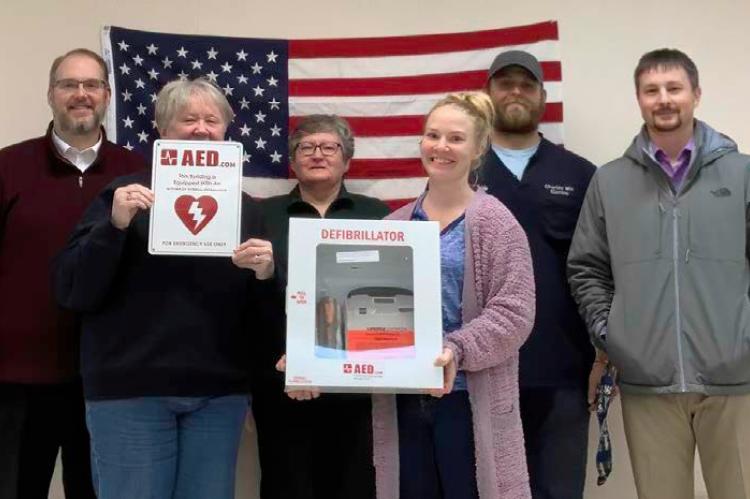
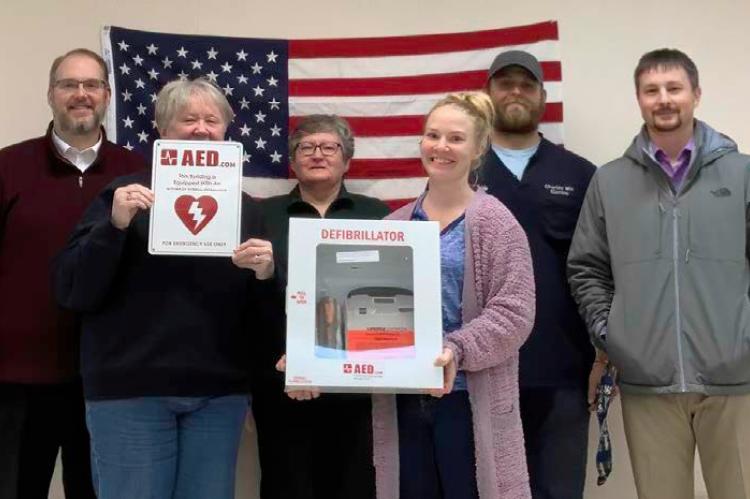
The Lake Andes Community Building Board received an AED purchased by the Lake Andes Food & Wellness Council, part of the Well Connected Communities initiative. Rural communities often lack access to life saving tools that are needed in the midst of an emergency.
An AED was purchased to increase access to these lifesaving tools in the event of a heart attack providing the individual with a better chance of survival.
AED Access in Rural Communities Cardiac arrest survival rate is lower in rural communities than in urban areas. South Dakota ambulance responses could range from a few minutes to more than 30 minutes.
Many factors affect an individual’s chance of survival from an event including the involvement of bystanders and their ability to perform immediate interventions. Rural communities often have much lower availability and access to AEDs.
Collaborative Response Cardiovascular events require collaborative efforts from all community members. This not only includes community health professionals, but all members of the community. During time sensitive emergencies such as a heart attack or stroke, every second that passes without immediate intervention could be the difference between survival and death. According to the American Heart ssociation, immediate cardiopulmonary resuscitation (CPR) and early defibrillation, with an automated external defibrillator (AED), can more than double a victim’s chance of survival. Empowered community members should be prepared in a situation of which one is experiencing a cardiac event before the EMS arrives. This collaborative response allows for a better system of care and a better chance of survival for the individual experiencing the event.
American Heart Association (AHA) Chain of Survival: The AHA’s 5 step chain of survival for the individual experiencing a cardiac event are as follows:
1. Early recognition of cardiac emergency and calling 911
2. Early CPR with high quality chest compressions
3. Rapid defibrillation: use of an AED by layperson or health professional
4. Effective basic and advanced emergency medical services
5. Advanced life support and post cardiac arrest care It is important to note that all parts of the community are involved in the response of a cardiac event. When the community is prepared with knowledge and tools, better outcomes are possible. In rural areas, outcomes depend on this even more.
Increasing trained individuals in response to a heart attack as well as providing more availability to AEDs will lead to a better chance of survival. Thanks to the Lake Andes Food & Wellness Council via the Well Connected Communities initiative, the Community Building is now equipped with an AED. To learn more about the Lake Andes Food & Wellness Council, contact Mary Jo Parker.