

KOREA REVISITED
KOREA REVISITED
Alyssa Mathis News@hcinet.net
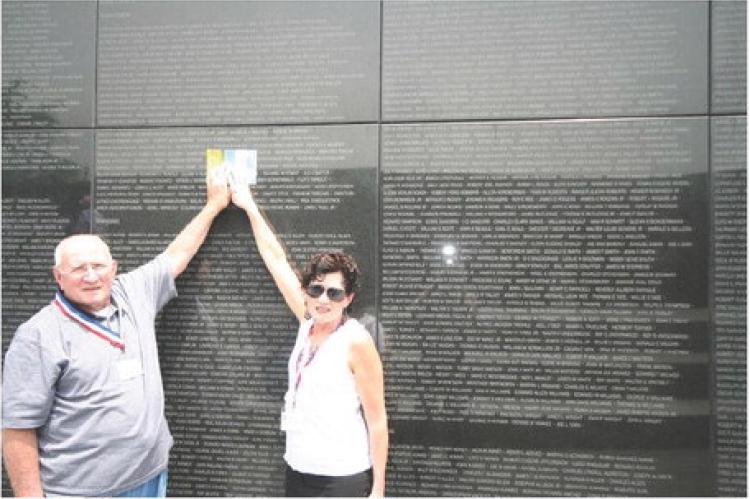
Colonel Robert Monfore better known as “The Colonel’s” military service spanned through three wars WWII, Korea and Vietnam. The Colonel enlisted in the Army 12 days before his 18th birthday on September 26, 1946. The Korean War began on June 25,1950 and ended on July 27, 1953. It is because of the upcoming day of July 27th also known as Korean War Armistice Day which celebrates the signing of the Korean Armistice Agreement in 1953, ending the Korean War that observe this day through the account of what one local family like many others sacrificed and experienced during the Korean War. The Colonel and his daughter, Mary Hurd, were able to visit Korea as part of a special invitation for a Korean War Veteran’s Tour by the Republic of Korea’s government. Samsung and the Republic of Korea partnered to make the Korean War Veteran’s Tours reasonably priced for a Veteran and one person to accompany them on the trip. Here is The Colonel and Mary’s story and experience as told through Mary’s daily emails to home and memories from this once in a lifetime experience. The Korean War was not the first time that the Colonel was stationed in Korea. His first time being stationed in Korea was in 1949. He would later be stationed in Korea again in 1968-1970, this time bringing his wife and children along with him. The Colonel spent 1952 and 1953 in Korea during the Korean War. The Colonel was an engineer in the Army. He was a construction and maintenance advisor for the 206th Engineer Construction Battalion leaving him assigned to building roads, bridges and constructing defensive positions during the war. As he had lost his brother, Peter Howland Monfore, on September 19, 1951, during the battle at Heartbreak Ridge in the Korean War, The Colonel was kept out of combat zones during his service. Even after the Korean War ended in 1974, The Colonel stayed in Korea in order to be an advisor to the Republic of Korea troops as they constructed military facilities. For his service in the Korean War, The Colonel was awarded The Army of Occupation (Korea) medal for his service in 1949; The Korean War Service Medal for his service 1952-53; the National Defense Service Medal; the Presidential Unit Citation (Korean War) Medal; The Armed Forces Expeditionary Medal; and the United Nations Service Medal. The Colonel retired from the United State Army in 1974 as a Colonel after serving for almost 28 years. In August of 2008, The Colonel received a special invitation from the Republic of Korea Government about their “Revisit Korea Program for Korean Defense Veterans”. The program was created in 1975 to show appreciation for the United State Veterans’ service during the Korean War. Every year 300 Veterans are invited to attend Korea through this program, to date 30,000 United Nation Korean War Veterans have been invited to Korea through this program. As that specific tour date would not work for The Colonel or Mary, they asked if they could attend a different tour. In May of 2009, The Colonel, 77 years old, and Mary set out for their 13-day, 11-night tour to revisit Korea. Mary remembers her father being excited about the visit because he had wondered what Korea looked like after being away from the country for 39 years. Mary was also excited to go on this tour as she remembered Korea being a beautiful country, but most importantly she was excited about being able to share this experience with The Colonel as it was not going to be like anything that the two had done before together. The tour took them all across South Korea. Each day they were in a different part of the country and in another city. Some of the sites that they were able to visit were Camp Red Cloud, the Korean War Museum, the Bridge of No Return, Iron Triangle Battle field area, Battle Field White Horse Hill, Korean Invasion Tunnel, The Largest Loyal Spirit Monument of Korean War, United Nations Memorial Cemetery Park, Geo-je POW Camp, Korean War Museum, Seoul Tower Observatory of Seoul City, Gyeongbook Place 500 Years of Yi (Jeseon) Dynasty, and Heartbreak Ridge. One of the most complicated and heart felt parts of the entire trip was when their tour went to visit Heartbreak Ridge. As the tour coordinator knew that The Colonel had lost his brother at Heartbreak Ridge, the coordinator arranged for the tour to be able to visit there which was not an easy task due to its location. The Battle at Heartbreak Ridge was a month-long battle where 30,000 soldiers lost their lives from both the United Nations and North Korea. Among those lost at Heartbreak Ridge on Hill 851 was The Colonel’s brother, Peter Monfore. A great coincidence on the tri was that one of the other Veterans on the tour, Richard Oroscoe, had known The Colonel’s brother and had been on Hill 851 up until a week before Peter’s death. The day the tour visited Heartbreak Ridge, the tour of 13 people made the journey to Hill 931 which is the closest that one can get to view Hill 851 and still be safely in South Korea. Hill 931 lies right south of the Demilitarized Zone (DMZ). The Korean DMZ is a heavily militarized strip of land running across the Korean Peninsula near the 38th parallel north and also serves as a border barrier between North and South Korea. The tour made the journey two thirds of the way up the hill until they arrived at an outpost. They were led into a reception room where they were shown a presentation about the history of the Republic of Korea and each Veteran was asked to share their story. After they were presented with several gifts, they were each issued camo jackets so that they would blend in looking like soldiers. They were loaded into a convoy of jeeps to complete the 40-minute trek up the rocky, winding and sometimes muddy road to the top of Hill 931. At the top of Hill 931 sat a memorial stone where they each were given a white flower to place at the bottom of the memorial. Then one of the officers used a large chart to explain the Battle at Heartbreak Ridge to the tour. The officer pointed to Hill 851, which was very close to their location, only two hills over and the first hill into North Korea. The tour was allowed to take some video and pictures, which is not normally allowed that close to the DMZ. One of the most moving moments of that part of the trip was when one of the Veterans who was in a wheel chair was carried up the steps to the monument by Republic of Korea soldiers. Unfortunately, their time was cut short when suddenly the tour members were all whisked back into their jeeps and headed back down the hill as there was increased activity from North Korea’s military outpost opposite of Hill 931 and they wanted to ensure everyone’s safety. Another highlight of the trip, was being able to visit the Korean War Memorial in Busan. Located at the memorial is not only have the United Nations Cemetery, but also the Wall of Remembrance. The Wall of Remembrance has the engraved names of the 40,896 soldiers of the United Nations including both those that were killed in action and those that are missing from the Korean War on 140 marble panels. During this tour, Mary and The Colonel were able to find Peters name engraved on the Memorial. It was a powerful site to see all of those names and feel the enormity of the how many people gave their lives during the Korean War. The names were grouped by state and the panels documented every name of every person that was lost, so that their sacrifice would never be forgotten. After reading Mary’s emails about the entire trip, one of the overwhelming threads that ran through the entire trip was the incredible gratitude that South Koreans still feel towards those soldiers that fought in the Korean War. Everywhere the tour went, the local people would engage the group in conversation and thank the Veterans for their service and saving their lives and the lives of their children and grandchildren. Many of the Koreans reached out to touch them on the shoulder or shake their hand. When asked how she felt that this trip ended up being for her father, Mary said that even though he never said it that this trip was therapeutic for The Colonel. She believed that her dad being able to see where his brother died while in service to both the United States and the Republic of Korea gave him a sense of closure. The Colonel had been the soldier to escort his brother’s body home to the United States. It had taken over a month to retrieve his body in order to send Peter home. As The Colonel was stationed with the family in Korea, Mary wanted to go and visit the house that they had lived in. The actual house that they had lived in was no longer standing, but they were able to visit the area. It brought back many fond memories that both her and her father reminisced about it. Mary remembers that for her 8th birthday, she received a German Shepard and the dog accompanied the family to Korea. She remembers vividly while living in Korea, the dog would bark at the telephone lines whenever a bird would land on one. When asked what her best memory from the trip was, Mary recounted one of the experiences at a museum. She and her father were outside of the museum just looking around when The Colonel saw an elderly Korean man dressed in traditional style clothing. Without speaking a word, both The Colonel and the Korean man started moving toward each other. The Korean man had part of his skull caved in. When the two men were within an arm’s reach of each other, The Colonel reached up and touched the Korean man’s skull and the Korean man touched The Colonel’s cheek. They both just stood, looked at each other and smiled. Even though not a word was uttered during the entire exchange, no words were needed. They had both lived and fought through the same experience, the Korean War. For Mary it was a powerful moment that she will never forget. The Colonel and Mary’s experiences were a true testament to the outcome of the Korean War. Freedom is not free, and some gave all are two phrases that are very meaningful when it comes thoughts on the Korean War. While The Colonel served, his family and ultimately his brother gave the ultimate sacrifice. Peter will never be forgotten and neither will those that were lost in the Korean War, nor will the service and sacrifice that so many other soldiers gave during the Korean War. A special thank you to Mary Hurd for sharing her experiences, pictures and emails with me in order to be able to write this article. This article is dedicated to the brave men that served in the Korean War and their families that served in their own ways home in the United States. Your service and sacrifices will never be forgotten.