

GREG MATHIS HONORED AS THE MARCH VETERAN OF THE MONTH
GREG MATHIS HONORED AS THE MARCH VETERAN OF THE MONTH
Alyssa Mathis
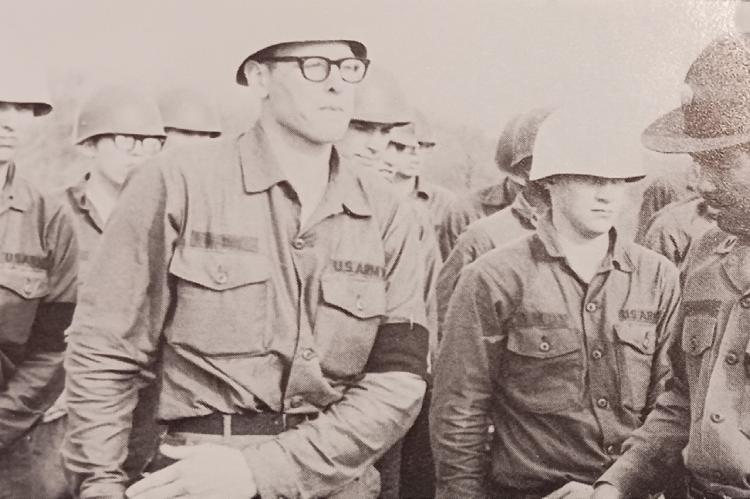
The American Legion Auxiliary Greer Unit #11 is honoring Greg Mathis as this month’s Veteran of the Month.
Mathis is a Veteran of the Cold War. Greg started his service on April 9, 1975 with the Army. He joined the Army because he thought the military would be a good opportunity for him. Mathis did his basic training at Fort Leonard Wood, MO for eight weeks. After several weeks of basic training, Greg was chosen as an acting sergeant and was in charge of his own squad.
After basic training, Mathis was sent to Fort Gordon for his Military Occupational Specialty (MOS) as a 31M20 MOS (aka 31 Mike) which is a communications equipment operator. As a 31M MOS, Gregory supervised, installed, operated and performed maintenance checks and services on manual or automated tactical multichannel communications equipment. They also set up antennae and would run crypto cards through the system in order to keep communications secure so the Russian and German armies could not pick up their communication, even though US soldiers did run maneuvers with German soldiers.
After completing his communications training, Mathis was flown out of New York to Berlin, Germany. He stayed in Berlin for three days before being sent by train which was full of Russian soldiers away from Berlin and the Berlin Wall to Frankfurt, Germany. Mathis could not be stationed in Berlin because there was no need for his particular MOS. After arriving in Frankfurt, Mathis was sent straight to the field for four months. He began his time serving in Germany as a Private First Class (PVC) but within a couple of months he was once again wearing acting stripes and had several platoons under his leadership.
Mathis’ platoon was sent high into the Taunus Mountains where he and his fellow soldiers had to run all the wires and lines by hand and use a generator to power them. To get high into the mountains, the squad used gama goats, which are vehicles made to travel over exceptionally rough and muddy terrain. Being up in the mountains running communication lines, put the soldiers in a very vulnerable position because should there be any conflict (especially since there were Russian soldiers on the other side of the mountains), they would be the first group that the opposition would want to harm and disarm to hinder the US’s communications. Mathis and his platoon also had to carry out night missions in order to be prepared in case the need would arise. Mathis would spend between 15 and 20 days of the month out in the field. Eventually Greg would run communications for the Top Brass, which were staff Officers.
Mathis was sent to Germany as he was quite fluent in German, having taken 2 years of it in high school which definitely helped him while he was stationed there. While in Germany, he spent time with a local German family who had a small child and the motherin- law all living together, because in Europe there were no such things as nursing homes. It was very interesting for him to spend time with the family because of the questions that they asked about living in the United States such as “did Americans still travel by stagecoach?”
Greg was allowed to live off base, because he was too tall for the base beds and also had a car, so he never really experienced the transportation systems of Frankfurt. Mathis enjoyed the R & R he took while he was stationed in Germany. His grandmother, Fern Stoddard, traveled to Europe for Eastern Star; Mathis took two weeks of R & R and traveled to Switzerland, Amsterdam, Belguim and around Germany with her. Greg was also lucky enough to have a first cousin, Clyde Mathis, get stationed in Germany as well. The two of them would take R & R and travel together all over Europe. They especially enjoyed visiting Holland and Amsterdam.
In January of 1977, Mathis was sent high into the mountains for maneuvers during negative 20–30-degree weather. He was not wearing the right kind of shoes for the excursion because his feet were size 16/17. After coming in from the maneuver, Mathis’ feet were frozen solid. He then spent the next 25 days in the hospital with his feet elevated trying to help with circulation and blood flow. He was then released and sent back to the same place in the mountains; the weather had changed and was not as cold. This incident would prove to be a very significant event that would affect Mathis later in life.
In July of 1977, Mathis went in front of the Promotion Board and received his rank of E5 and finally became a full-fledged Sargent with stripes. Mathis finished the rest of his service in Frankfurt before returning to New Jersey where he received his honorable discharge from the Army. Mathis was released from active duty on March 31st of 1978. Upon returning home, his own aunt did not even recognize him. He went into the Army at around 245 pounds and came home at 160 pounds. One interesting side note is after being home for a couple of months, Mathis finally received several custom-made winter boots that he should have had while he was stationed in Germany.
As this was Mathis’ first real time leaving South Dakota, he had many highlights being stationed in Germany. Mathis was able to attend the 1976 Winter Olympics in Innsbruck, Italy and see several of the skiing events. According to Greg, Germany has some of the best food in the world. He experienced pomfritz which are French fries and paired them with mayo, which became an instant favorite for him even until this day. Being able to travel all over Europe, especially with family was also a huge highlight making many life-long memories for Mathis.
During Mathis’ service he received The Army Commendation Medal, which is the highest medal that can be earned in the Army during peace time. Mathis received this honor for “meritorious service while serving as pulse code modulation multichannel team chief, Company B, 143rd Signal Battalion during the period 7 April 1975 to 8 April 1978.” He also received awards as an expert in rifle and hand grenade.
Greg was born in Mitchell and was raised in Plankinton. After returning home from the Army, Mathis farmed with his dad, Wilbur, for about a year. While attending a dance in Mitchell, he met Carolyn Reinschmidt. They danced together once and of course Greg being the ladies’ man that he thought he was asked her if she would like to go out the following Friday night, but she said that she was busy. Several months later, out of the blue he received a phone call from Carolyn and they started dating. After a year together, the two were married in Wagner at the Methodist Church in September of 1981. The couple had three children Alyssa, Ashley (Gullikson) and Nathan. The Mathis’ have four grandchildren Jackson, Avery, Natalie (Peanut), and Brock. Greg moved to the Wagner/Lake Andes area in 1981 to farm with his fatherin- law, Doyle Reinschmidt and has been farming ever since. He also raised hogs for many years until the market fell out and hogs were being sold for nine cents a pound.
Mathis has had several hobbies over the years. He was an avid goose hunter for 24 years, always enjoyed fishing on a boat with his friend Joe, playing cards, talking of course and going to morning coffee. He also was a part of several organizations including a fireman for the Ravinia Fire Department for 30 years, a member of the Wagner American Legion for 30 years (he served as commander for three years and vice commander for six years), a member of the East Lake Andes Lutheran Church, and has served as the president, vice president, secretary and treasurer for the church council.
Thank you, Greg, for your service and sacrifice and for being this month’s Veteran of the Month. On a personal note, the service that Greg gave to this country has come at a great cost to him health-wise. The initial freezing of his feet while serving has caught up with him in the latter years of his life and he now suffers from chronic pain because of it. As his daughter, I am very proud of his service especially knowing what it has caused him to sacrifice when it comes to the hobbies and activities that he loved to do but now cannot and the pain that he endures.