
GRAIN BIN ACCIDENTS AND DEATHS RISING DUE TO POOR CROP CONDITIONS
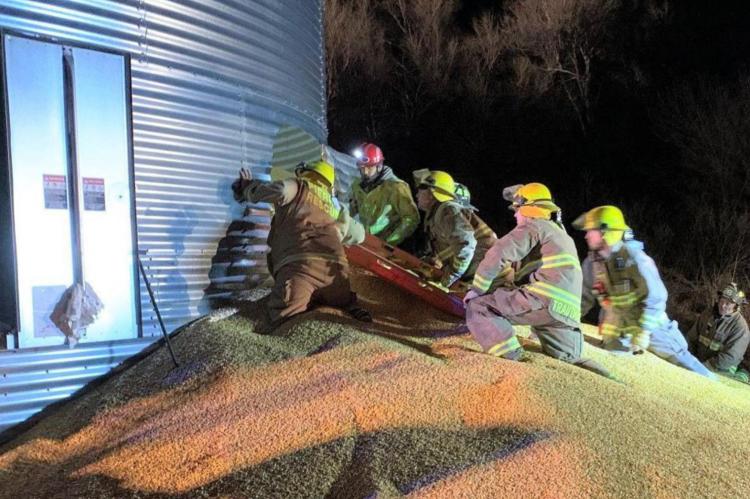
Wet and cold weather in 2019 have created a dangerous situation this year for South Dakota farmers who store grain in bins, heightening a risk of entrapment or death that has existed on farms for generations.
The number of reported grain entrapments across the country rose by 27% from 2018 to 2019, and deaths rose by 53% that year.
South Dakota in 2020 has already seen the death of a 27-yearold father of three in Brookings County in February and the entrapment of a farmer who was rescued from a grain bin in Hughes County in March.
Heavy rainfall and brisk harvest conditions throughout 2019 across the 10-state “corn belt” that includes South Dakota led many farmers to harvest grain crops later than usual and produce grain that was immature or damper than normal.
Those factors from the 2019 harvest, in addition to the use of old, leaky bins on some farms, have combined to reduce the quality of grain being stored and result in a product known as “out-of-condition” grain.
The lack of consistency and low quality of the grain make it more likely to clump, stick to the sides of a bin or form a crust over the top. Those conditions make the grain flow less freely from the bins and make it more likely farmers will have to enter the bins to keep the grain moving, said Jeff Adkisson, a farmer who is vice president of the Grain and Feed Association of Illinois and also serves on the board of the national Grain Handling Safety Council.
“Grain quality is directly linked to safety,” Adkisson said. “This particular crop is not storing well. It came in wet, it didn’t dry down very well and there’s a lot of broken material in the bins. As a result, we have seen an uptick in situations where people have become engulfed and trapped or have died in grain bins.”
Farmers typically store grains such as corn and soybeans in elevated bins from the time of harvest in the fall or early winter to use as feed or to sell in the spring or summer. The gray metal structures, often cylindrical in shape and hold from 1,000 bushels to up to 2 million bushels.
One foot of grain in a bin can create about 300 pounds of pressure, so even with just two feet of grain surrounding a body, it takes an enormous amount of pull strength to lift someone out.
Entrapment and full engulfment can occur very quickly. According to OSHA, a person in a bin has only two seconds to react once grain starts flowing beneath him. Entrapment can occur in four to five seconds, and full engulfment can result in only 22 seconds.
The United States averaged about 35 reported grain-handling incidents per year from 2005 to 2015, about 60% to 70% of which were fatal, according to Purdue University. The actual number of entrapments is likely a third higher because many non-fatal incidents are never reported.
OSHA rules do not apply to farms with 10 employees or fewer, meaning that small family farms that make up the majority of farms in South Dakota and elsewhere are not subject to any safety rules. Field’s research shows that 70% of entrapments happen on farms that are exempt from OSHA rules.
On March 7, a farmer on a Hughes County property about 30 miles southeast of Pierre became trapped in a grain bin to mid-torso depth for about six hours before being rescued by rescue workers from three fire departments and a grain company. The man entered the bin and became trapped in the corn, at which time another person on the scene was able to secure a rope around the man’s chest to prevent further slippage into the grain.
Attempts to build a temporary “tube” around the man to lift him out from above failed, so responders had to use saws to slowly cut holes in the bin to drain the corn and reach the man with a stretcher. The man suffered non-life-threatening injuries.
In South Dakota, the February death of farmer Christopher Bauman has resonated with the entire state agricultural community.
Though Christopher’s death was not believed to be related to out-of-condition grain, the tragedy has served as a reminder of the risks associated with storing and handling grain.
Christopher, 27, was one of two sons of Don and Sherry Bauman, and both boys grew up on the family farm near Elkton in eastern Brookings County. Both Christopher and his brother, Justin, 29, graduated from Lake Area Technical Institute before returning to work on the farm with their father.
From a young age, Christopher was entranced by farm life and work, his father said.
“That’s all he wanted to do, from the time he could play with toy machinery to when he was running the real machines,” Don Bauman, 59, told News Watch. “He couldn’t wait to get home and be involved in the farm.”
Christopher married his wife, Cecily, in 2013 and they had three children, now ages 5, 3 and 18 months.
Christopher, Justin and their father ran a 110-head dairy operation and produced corn, soybeans, wheat and alfalfa.
Christopher had a reputation for being involved in his community and supporting his neighbors.
“He would stop and help any neighbor whether they needed help or not,” Bauman said. “He would just stop by, and he would stay there and help them until everything was done.”
On Feb. 17, the three men were out on the farm together, and Don and Christopher were removing corn from a bin for Christopher to take into town to satisfy a prior contract sale. Justin was grinding corn from another bin nearby.
The corn was in good shape and was being held in a 12,000-bushel bin that stands about 25 feet tall and 30 feet across, Bauman said. As the auger inside ran, the corn flowed out onto a conveyer that would carry it to a truck for transport.
A couple of minutes after the corn started flowing, Bauman noticed that Christopher was no longer with him.
“He walked around one side of the building, and I thought he was going to come around the other side to talk to me,” Bauman said. “When I realized he didn’t come around, we shut everything off.”
Bauman called Justin over and after a quick check around the outside, Bauman climbed a ladder to the top of the bin and looked inside, feeling around for any sign of Christopher.
He saw a slight downward cone in the middle of the bin but no sign of his son. After 911 was called, the pair opened a door at the bottom of the bin to begin letting out the grain.
A short time later, emergency workers arrived and cut holes in the bin to remove the corn, and eventually Christopher’s body was found inside.
“It was just horrifying,” Bauman said.
Looking back, Bauman has no idea why Christopher would have entered the bin from the top. He and his sons talked often about safety on the farm and had never had an accident. They specifically discussed grain-bin safety and that in no circumstance should they ever climb in when alone or if the auger was running.
“We had talked about that hundreds of times … so I don’t know why he did and I can’t speculate about that,” Bauman said.
Christopher’s death has devastated Bauman and their extended family, especially Christopher’s wife and children.
“They do as best they can,” Bauman said. “We told the kids that daddy’s not coming home, but they keep asking about it.”
Graphic option:
Grain bin and confined-space incidents and deaths on rise in U.S. Researchers at Purdue University in Indiana have tracked confined-space incidents on American farms, including grain bin entrapments and deaths, for 40 years. Here is a look at overall confined-space incidents and deaths and grain bin incidents and deaths over the past three years. Incident totals are likely a third higher because many non-fatal incidents are never reported.
Total confined-space
incidents/fatalities
2017 — 54 incidents, 23 deaths
2018 — 61 incidents, 27 deaths
2019 — 67 incidents, 39 deaths
Grain bin entrapments/fatalities
2017 — 23 entrapments, 12 deaths
2018 — 30 entrapments, 15 deaths
2019 — 38 entrapments, 23 deaths
Source: Bill Field, Purdue University