

THE FIRST QUARTZITE MARKER
THE FIRST QUARTZITE MARKER
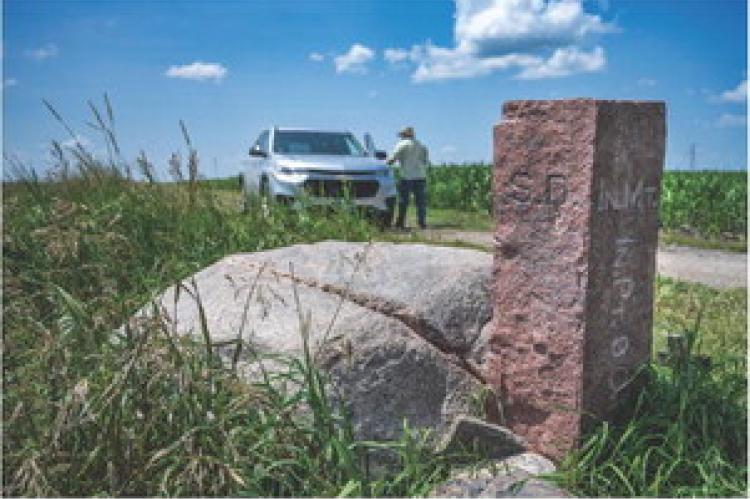
The new September/October issue of South Dakota Magazine includes a story about our continental divide, a unique area in the far northeastern corner of the state that separates two watersheds. Water on the north side of the line flows to Hudson Bay, while water to the south travels to the Gulf of Mexico. It is one of five such divides in the United States, and happens to run between Lake Traverse and Big Stone Lake, one of the lowest spots in South Dakota at 977 feet. We also wrote about a few interesting stops in northeastern South Dakota for readers curious to explore the divide and that part of the state. One stop is the quartzite border marker that stands where North Dakota, South Dakota and Minnesota meet. The story of surveyor Charles Bates and his task of marking the border between the Dakotas with these huge quartzite obelisks is fascinating and told remarkably well in Gordon Iseminger’s book The Quartzite Border. I found the story of this very first marker to be just as interesting in its own right, and I finally learned about its inscription, which was long a mystery to me. Bates was a surveyor from Yankton who won the bid to find and mark the 360-milelong border. His crew began in the fall of 1891 with the “initial marker,” which technically should have been placed at the spot where the seventh standard parallel intersected with the Bois des Sioux River. Because a marker couldn’t practically be placed in the middle of a river, his superiors at the General Land Office directed him to put it “upon the nearest solid ground favorable for its proper and convenient establishment and suitable for its protection and preservation,” Iseminger explained. Each side of the marker was inscribed: N.D. on the north; S.D. on the south; 1891 on the west; and “In. Mt.” for “initial monument” on the east, along with “In. Pt. 9 C. E.,” meaning the initial point was nine chains east. Bates placed 720 markers along the border. Many have been lost over time, and some have been moved, including this initial marker, which was relocated by members of the historical society in nearby Wheaton, Minnesota, after it was nearly toppled during construction of a drainage ditch. But this marker remains, a sentinel of the Glacial Lakes country. You’ll find it by following 102nd Street SouthThis quartzite border marker — the first placed by Charles Bates and his surveying crew in 1891 — stands where North Dakota, South Dakota and Minnesota meet. Photo by Chad Coppess east, a gravel road that turns into a two-track dirt path running right along the North Dakota/South Dakota border. Just a few hundred feet to the east, the waters of the Bois des Sioux River meander slowly north on their long journey to Hudson Bay. John Andrews is the editor of South Dakota Magazine, a bi-monthly publication that explores the people and places of our great state. For more information, visit www.southdakotamagazine.com.