
DUCK BANDING AT THE LAKE ANDES NATIONAL WILDLIFE REFUGE
DUCK BANDING AT THE LAKE ANDES NATIONAL WILDLIFE REFUGE
Alyssa Mathis
What is duck banding? Who does duck banding? Why is duck banding important? For most people these types of questions never even cross their mind unless they are a part of an ornithological organization, work for a wildlife organization or are a duck hunter. Duck banding is method that is used to help study different aspects of ducks as well as identify ducks through the use of a band attached to their leg, beak or foot. Duck banding is an important part aiding the Migratory Bird Division of the U.S. Fish and Wildlife Service in information regarding duck’s dispersal, migration, behavior, social structure, life span, population, estimated survival and productivity, toxicology, disease research which in turn helps them in their conservation efforts of setting hunting regulations and detecting changes in any waterfowl populations. All of the data that is garnered from each reported duck band is entered into the Bird Banding Laboratory (BBL) database to be used for analyses and studies.
The duck banding season is usually August and September annually. At the Lake Andes National Wildlife Refuge (NWR), staff members enjoy duck banding, but how many birds are banded annually really depend on the number of staff and other priorities of the refuge that take precedence. Unfortunately, due to the refuge’s small staff in comparison to their large workload, not a lot of duck banding is usually able to be done annually. Each banding station has a master bander permit that is obtained by a bander of record from the Bird Banding Laboratory. For the Lake Andes NWR that bander of record is, Mick Hanan. What this means is that Mick has to be present during the actual banding and supervise all banding related activities. The refuge has banded geese and mourning doves in addition to ducks, and their current permit also allows for the banding of swans, cranes and pigeons.
There are target goals nationally for the Migratory Bird Division of the U.S. Fish and Wildlife Service in regards to the number of ducks that need to be banded. Refuges like the Land Andes NWR as well as other refuges throughout the nation try to help with these targeted goals as much as possible. When asked how many ducks the refuge bands each season, Mick said that it is really dependent on the priorities, staff and method of capture available for use during the banding season. There are two methods that the Lake Andes NWF employs when it comes to catching ducks for banding including rocket nets and swim-in traps. Which method is used greatly affects the amount that the refuge is able to band each season. The rocket nets allow for the capture of tens or hundreds of birds at a time, whereas the swim-in traps catch a few to upwards of 50 at a time. This year the Lake Andes NWR was able to band around 50 ducks during the season. During the 2023 season no ducks were banded and in 2022 as well as 2021 they were able to band approximately 75 ducks each year.
The use of rocket nets involves first finding a flat open spot near the wetland edge. The area of 80 feet by 120 feet is mowed to create an attractive spot for ducks to walk up and feed. The staff bait the area with barley, wheat or corn in order to get the ducks in the area. Then a 40 foot by 60-foot net is rolled up and attached to ropes that are attached to projectiles or “rockets” that when triggered will carry the net over the bait and catch the ducks underneath. The swim-in traps work similarly to a minnow trap. Bait is first placed on top of a floating piece of styrofoam or wood in the water. After the ducks get used to the bait then a four-foot-tall wire trap is built. The trap is basically 1 inch by 2-inch spaced wire that is four foot tall and made in the shape of a circle, The trap is generally 10 feet by 15 feet in diameter.
Where the wire ends come together a funnel is formed in the shape of the top of a heart. This design allows the ducks to work their way around the trap and when they get to the funnel and go inside, they are trapped and cannot fly away as the trap also has netting over the top.
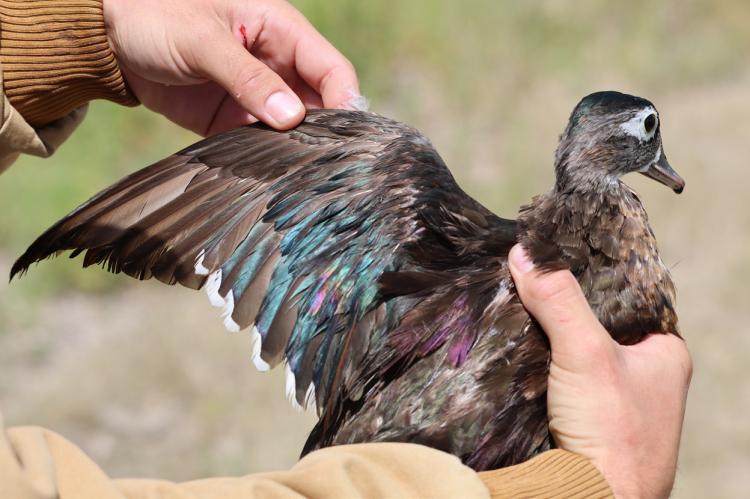
When asked what type of ducks that the refuge bands, Mick said that even though the national goals and objectives do target specific species, when it comes to banding on a dayto- day basis on the refuge any duck that is caught is banded. After catching the birds, the information recorded can vary based on the particular studies associated with the banding. Information that the refuge garners is the minimum and includes band number, banding location, date, species, sex, age, local, hatch year or if after hatch year then how it was aged, sexed and caught. There is a purpose for banding the ducks. By banding ducks, it now only tells the National Wildlife Service about the habits of the ducks but other migratory species as well. All kinds of birds get banded, but as not all birds are hunted and harvested there is not usually very much recapture information available. With ducks though, part of the population is banded and a portion of those end up being harvested by duck hunters. It is always hoped that when banded ducks are harvested that the duck hunters will report the band, that way it can be on record where the duck ended up. Bands on the ducks do sometimes fall off, but that is factored in when the laboratory analyzes the data.
If someone were to find a deceased banded duck or kills one during hunting season, the Lake Andes NWR encourages a person to report it. The Bird Banding Laboratory is hosted by the United States Geological Survey and has a website that makes it easy for people to report all of the bands they see or find. Information that is asked for by the site is where the band was found and how the person found it. There is even a certificate that is given to the reporter for reporting the found band. This website is found at http://www.pwrc. usgs.gov/BBL/bblretrv/.
Other refuges located in South Dakota that take part in duck banding include Sand Lake, Waubay, Lacreek and Huron Wetland Management District as well as the South Dakota Game, Fish and Parks. In addition to the various federal and state agencies that are involved in duck banding, various ornithological organizations including Ducks Unlimited, Delta Waterfowl, The Audobon Society etc. can also be involved in the banding process. The duck banding program has been a part of the Lake Andes NWR since at least the 1970s if not some years prior to.
As Mick is the bander of record, when asked what he enjoys about duck banding season, his response was that he started out his career banding ducks, and has been lucky enough to band tens of thousands of ducks over the past 20 plus years. Even if the team does not get to actually do much duck banding each year, it is always the year’s highlight. Part of what he loves about this annual event is the field work that allows him to hold a live duck in his hands that once it is tagged and released has the potential to be a resource of data. For Mick, it is when he releases the bird into the air or water that his mind begins to wonder and triggers thoughts of the possibilities for the bird. He thinks of such questions as “Will it migrate thousands of miles south?” Will it travel thousands of miles north?” Will it make many trips north and south over the years or will it not make it through the first year of life?” The list goes on about the possible life and activities that the bird will participate in during its life span. There is a plus for Mick as he is the bander of record for the refuge, he gets all of the reports from the birds that are banded under the Lake Andes NWR permit, so there are times when he does actually find out answers to some of his questions.