

CHARLES MIX ELECTRIC FIRST IN THE STATE TO IMPLEMENT NEW RATE SYSTEM
CHARLES MIX ELECTRIC FIRST IN THE STATE TO IMPLEMENT NEW RATE SYSTEM
Submitted By Russell Gall General Manager, Charles Mix Electric
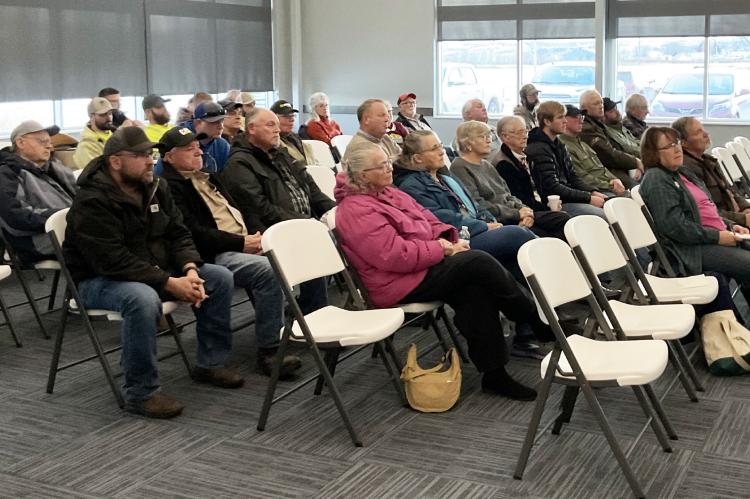
Several Charles Mix Electric members took advantage of three local meetings held in January to provide information on rate changes that will take effect on April 1st. In an effort to reach as many members as possible, Charles Mix Electric held district meetings throughout the county in Platte, Lake Andes, and Wagner.
Manager Russell Gall presented a slide show that covered factors contributing to the need for an increase, how the rate structure itself will be changing with the addition of capacity and demand charges, and how this new approach will actually apply the rates more fairly and equitably than in the past. He also presented three examples from low-end, medium-range, and high-energy users, comparing the monthly bill for each scenario under the current and new rate.
Charles Mix Electric will be the first cooperative in the state to implement demand rates to the entire membership. Manager Gall explained that nearly every electric cooperative in the state is on the path to demand rates. “Charging for electricity with four components is the fairest way to apply costs incurred by the cooperative to the members that create them.” The four-component rate will consist of a Service charge, an Energy charge, a Capacity charge and a Coincidental Demand charge.
What is new about the Service charge is that it will now match the actual cost to have electricity at any given location. Charles Mix Electric averages only 2 members per mile of distribution line, which results in a service charge of $84 per month. A bright spot in the new rate design is the flat Energy charge, which will lower the cost per kilowatt/hour to 3.85 cents. This lowers the cost of energy to one-third of the cost prior to the change, and is very near what Charles Mix Electric pays to its power supplier for the energy. The real change in the rates comes in the last two components relating to the specific use habits of the customers. Gall explained that “the Capacity charge is designed to recover the cost of the distribution system based on the load each member places on the system. This, too, creates a fair application of costs, since a member that creates a large demand for electricity on the distribution system will be billed based on that load.”
Finally, the last piece is the Coincidental Demand charge. Manager Gall went on to explain that “this new component is based on the member’s contribution of electricity demand on the region-wide electricity grid at the time of the system’s peak.” This is the point in time when electricity use is at its maximum level across a 13-state region, and reflects the cost of the generation and transmission lines needed to supply electricity during this period. Gall also added that “this charge nearly mirrors the cost that the cooperative pays to our power supplier.”
A significant amount of the presentation covered ways that members can be pro-active and manage their usage in an attempt to control or reduce the portions of their energy bill related to demand and capacity. Members were reminded that, although the monthly service is increasing, the rate for the actual kilowatt-hours used will be decreasing by almost 10 cents per kWh. Even though the service charge itself is fixed and cannot vary, members who utilize load management practices and consciously reduce their usage during peak times can realize savings on the demand portions of their bill. Each presentation was followed by a question-and-answer session, where members could seek further clarification. Questions were fielded regarding the benefits of electric heat metering, water heater controls, and the possibility of being notified in advance by text or email when peak load times may be occurring.
After the meetings, attendees thanked Gall for his explanations, and expressed that they came away with a clearer understanding of what to expect as the new rates take effect.