

BUILDING THE FUTURE: SOUTH DAKOTA COACH KAREN BROWN AND A GENERATION OF TITLE IX PIONEERS
BUILDING THE FUTURE: SOUTH DAKOTA COACH KAREN BROWN AND A GENERATION OF TITLE IX PIONEERS
Barb Bolton Walder
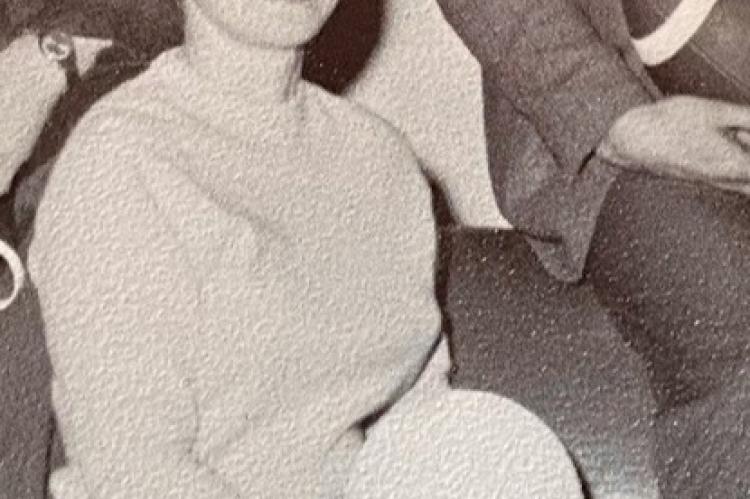
As women's sports take center stage in 2025—with record-breaking WNBA attendance, NCAA women’s basketball media deals reaching historic highs, and athletes like Caitlin Clark becoming household names—the seeds of that success were planted decades ago in places like Springfield, South Dakota.
Before there were packed arenas, TV cameras, and million- dollar sponsorships, there were college coaches like Karen Kaberna Brown—fighting for gym time, driving the team “stretch” wagon to games, and mentoring athletes who had never played organized sports before college. Brown’s 16-year career at Southern State College—later named the University of South Dakota at Springfield—helped lay the foundation for the athletic opportunities South Dakota girls and women have today.
“We had no assistant coaches, no bus drivers,” Brown recalled. “I remember having to drive the ‘stretch’ well over the speed limit just to keep up with Donnie Baker who was speeding at 80 mph to make up time.”
Brown coached volleyball, basketball, softball, track, and cheerleading—often on the same day she taught 7:30 a.m. PE classes in gymnastics, badminton, health, kinesiology, and archery. Her athletes were among the first generation of South Dakota women to step into a new era of sports equality, made possible by Title IX’s passage in 1972.
When the U.S. Congress enacted Title IX—a sweeping civil rights law that was just one short, powerful sentence in the Education Amendments Act— it sent shockwaves through every gym, field, and locker room in the country.
“No person in the United States shall, on the basis of sex, be excluded from participation in, be denied the benefits of, or be subjected to discrimination under any education program or activity receiving Federal financial assistance.”
Title IX promised equal footing for girls in high school, women in college, and future female coaches, but making it happen required persistence.
At USD/S, Brown’s women’s teams thrived in the AIAW (Association for Intercollegiate Athletics for Women) conference. “We were undefeated in the AIAW conference for several years,” she said. Her athletes regularly beat teams from SDSU, USD, Black Hills State, and Northern—even as they trained with less funding, fewer resources, and no assistants.
“We all started with nothing,” rememberedBarbWalder, one of Brown’s former college track athletes who graduated in 1974. “There were no female coaches to look up to yet—we were the beginning.”
Many of Brown’s players went on to become coaches themselves—Donna Schmitz, Gregory, SD; Janet Fryda, Tripp and Tyndall, SD; and Walder, Mt. Vernon and Brookings, SD—shaping the first wave of girls' sports programs in South Dakota high schools.
“Coaching those teams was hard work,” said Walder. “We didn’t always win, but we always showed up. And whether we were running track in the bitter SD winds or loading onto a school bus for an away game or meet, I never forgot where it all began—for them, and for me.”
It wasn’t just the physical game they had to learn—it was how to fight for equal footing. Janet Fryda recounted a moment when her local school board refused to add volleyball as a sanctioned sport. “Ruth Rehn representing the South Dakota High School Activities Association came to a board meeting. During the volleyball discussion, a board member told her that if she wanted volleyball, she’d have to pay for it. Ruth stood up and calmly said, ‘Okay, I’ll see you in court’. And just like that, volleyball was added.”
Donna Schmitz, who would eventually lead her volleyball teams to 11 state tournament appearances and produced 12 All State girls, credited Coach Brown as the spark. “I definitely believe I owe most of my success in volleyball to my college PE teacher, coach, and mentor, Coach Brown. Her continued support throughout the years helped shape my coaching philosophy,” Schmitz said.
Now, more than 50 years later, women’s hard-won victories are paying off on a national stage. South Dakota sports fans are watching as Caitlin Clark—a small-town Iowa native—sells out arenas in the WNBA, while South Dakota’s own female athletes earn Division 1 scholarships, appear in nationally televised games, and continue the fight for equal treatment in athletics. The country is witnessing the next chapter of Title IX in action— and the reason it’s happening is because of people like Karen Brown and the young women she coached.
Even after the heartbreak of USD/S closing in 1984—a closure that still stings for many—Brown never stopped teaching. She’s now 80 years old, living near Wagner, SD, and in her 27th year at Marty Indian School. She has never lost her passion for inspiring students.
In June 2025, a group of her former athletes gathered in Wagner, SD to reminisce and visit the Springfield College Museum. They laughed, told old stories, and remembered what it was like to be part of something bigger than themselves. “USD/S made me who I am today,” Brown said.
Her story, and those of the women who learned from her, are the backbone of today’s sports headlines.
The arenas may be bigger now. The paychecks certainly are. But the heart of women’s sports—the persistence, the grit, the belief—was forged long ago in places like Springfield, SD.
As Walder put it, “I see it now every time I watch a high school girls’ team warm up in matching uniforms, or hear a female referee blow her whistle, or see a coach holding a clipboard with fire in her eyes. That’s the legacy. That’s why it mattered.”
And that’s why it still does.