

BREAST CANCER SURVIVORS' JOURNEYS
BREAST CANCER SURVIVORS' JOURNEYS
Alyssa Mathis
The month of October is National Breast Cancer Awareness Month. According to Cancer.org, in 2024, there will be an estimated 310,720 new cases of invasive breast cancer in women and 2,790 new cases in men. Breast cancer is the most common cancer found in American women after nonmelanoma skin cancer. Even though women of any age can be diagnosed, the average age of American women who develop breast cancer is 62 years of age with only 9% of all new breast cancer cases in the United States being diagnosed in women younger than 45 years old. Even with this data and statistics, it is very important after turning 40 years of age to not only get a yearly mammogram, but to also do monthly self-checks in order to aid in early detection and diagnosis.
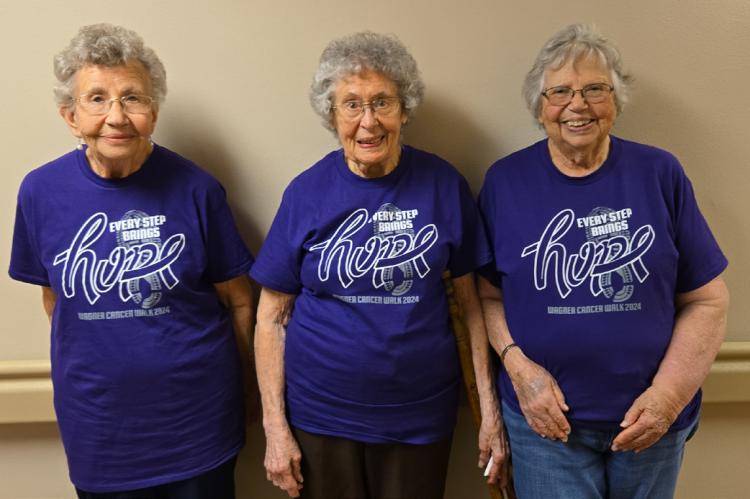
Three Wagner ladies that each had their own breast cancer survival journeys are Beryle Uecker, Lucille Kostel, and Beverly Beeson. While these ladies are currently in their 80s and 90s, having battled cancer in the mid to late 1980s and early 1990s, their breast cancer journeys are still a very well-remembered part of their lives. For sisters, Beryle and Beverly, cancer was a part of their lives from a young age as their mother was diagnosed with breast cancer and passed away at the age of 37.
Beryle was diagnosed in 1986 with ductal breast cancer in her left breast. When faced with the decision of what to have removed, Beryle initially chose to have a lumpectomy, meaning that the doctor would just remove the cancerous tissue. Unfortunately, after multiple complications including two failed reconstruction surgery, Beryle decided that she did not want to continue going through with the implants and instead chose to have them both removed.
Lucille is actually a two-time breast cancer survivor. She was first diagnosed in 1991 with cancer in her right breast and then again, several years later, with a different type of breast cancer in her left breast. Both times, she leaned on her sister for support and help. With each cancer diagnosis, Lucille chose to have each breast removed. She decided to have reconstructive surgery on the right breast but opted not to reconstruct the left breast and instead wears a breast prosthesis. Lucille started walking after her first cancer diagnosis, walking three to four miles every day. She feels that walking had a real impact on saving her life.
For Beverly, there was no need for the removal of her breasts. Instead she was given the option of a combination of chemotherapy and radiation treatments. Every week for six months Beverly received cancer treatment. Due to the intense nature of her chemotherapy treatments, Beverly lost her hair, and suffered from severe migraine headaches.
Even though each of the lady’s stories differ, they all share common threads. The first being that there was very little support at that time period for anyone who was diagnosed with cancer. No one wanted to talk about cancer, leaving many individuals to battle it alone. It is not like it is today, where communities, organizations such as the Pink Ladies and support groups are available to those who are battling and or who have survived cancer.
Their reactions to being first diagnosed with cancer were all very different as well. For Beryle, she said she knew that it was coming, especially since her mother had battled breast cancer. Lucille can remember that after first being diagnosed that her daughter had received a scholarship to continue her education in England. Her daughter was not sure about going to England after learning of her mother’s diagnosis, but Lucille assured her that going was the right thing to do. Beverly’s first thought when hearing that she had cancer was that she was going to pass away. She felt that what she had watched happen to her mother would be Beverly’s fate as well.
These ladies share their journeys in hope that it will leave a lasting impression upon the women of their community to take care of themselves by getting yearly mammograms, doing monthly self-checks and seeing a doctor as soon as symptoms or pain arises instead of putting it off. Doing so can save lives by detecting the cancer in its early stages and hopefully minimizing any needed treatments.