

AVERY SCHACHT, A WILDFIRE FIREFIGHTER
AVERY SCHACHT, A WILDFIRE FIREFIGHTER
Alyssa Mathis
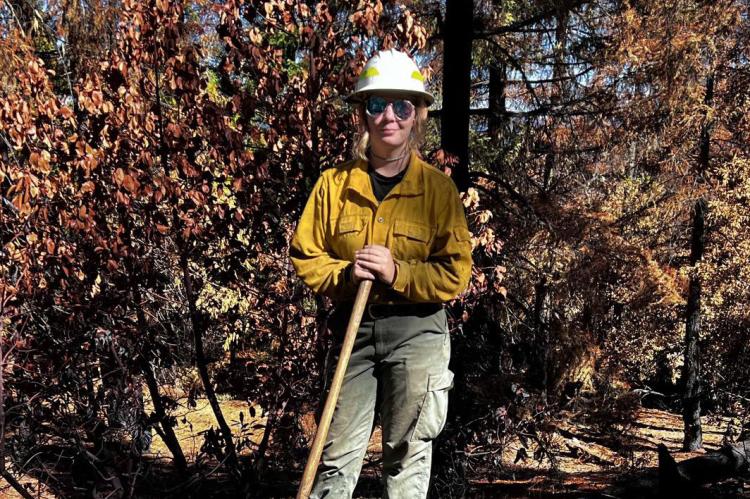
Avery Schacht is a volunteer fire fighter for the Lake Andes Fire Department and has been since 2021. She joined the department as soon as she turned 18 years old. Even though firefighting has become a way of life for Avery, it was not even on her list of career options until she was 16 when her interest in becoming a firefighter was sparked. She wanted to help her community and see what opportunities that firefighting could offer her. Avery is currently enrolled to take her Fire 1 and Fire 2 classes and has completed the introductory classes to be qualified as a wildland firefighter. She plans to continue to learn more about firefighting and advance in the industry. One certification that is at the top of her to do list is to become a sawyer. A sawyer is a wildland firefighter who cuts down trees and vegetation to create firebreaks in order to help manage the spread of wildfires.
This is Avery’s first year as a wildland firefighter. In total she has traveled three months over the course of this past summer. Even though she has not traveled as much as she had hoped, she is thankful to have gotten the opportunity to see the spectacular countryside of Colorado, Wyoming, Nevada, Utah and Northern, California. During this particular firefighting trip, she has been fighting fires for the past three weeks. Unless their job gets extended, Avery will return to Lake Andes on October 25th.
What Avery really enjoys about being a wildland firefighter is the bonds that are made between firefighters, becoming family away from home and lifelong friends. Wildland firefighters belong to a very small circle of individuals with many of them knowing each other even though they reside states apart. Even though the terrain can be difficult to maneuver especially for the distances that the firefighters have to cover, the views that she gets to see and be surrounded by more than make up for it. Avery has gotten to see places where people have never ventured to before.
What motivates Avery to engage in this type of work is her love for the job. It allows her to be outside all of the time, the work is always interesting and with each fire being different she is always learning and her knowledge of firefighting evolving. It is a career that she never saw herself doing, but now could not imagine not being a part of her life.
When asked if there were any special techniques that are unique to wildland fires, Avery said that there were not, but that it is very different than volunteer and structural firefighting. Due to the locations of wildfires, the firefighters have to walk quite a distance to reach their destination with their only tools being a shovel, an axe and a chainsaw. As they are walking toward the fire, they lay out hose in order to use water to assist them. When the firefighters reach the fire location, one of the first things that they usually do is dig a hard line to slow the spread of the fire or to contain it. The hard line is dug into the dirt with the team’s tools, so that once the fire reaches the line, it cannot continue on that path. While fire team members are digging the hard line, the sawyers are clearing the brush and trees around the line in order for the fire not to have anything to continue on its path of destruction. At most wildfires, dozers are usually on hand that do the same things as the hardline diggers just faster and on a much larger scale. These techniques work well for ground fires, but not when the fire spreads via tree tops. Then the firefighters have to rely on airplanes and helicopters to dump water or make a retardant line to stop or slow the fire. After the airplanes and helicopters have the fire contained, the firefighters go in and make a line while removing the trees that could once again help spread the fire. One other tactic that can sometimes be utilized in wildfires is a back burn which is used mainly to protect structures and the firefighters themselves. When utilizing this technique, the firefighters will light a fire that burns towards the current fire. A back burn can stop an uncontrolled fire because a fire will not burn what has already been burnt. Wildland firefighters often have to work day and night to be able to stop the fires as quickly as possible in order to minimize its effect on the wildlife, vegetation and residents of the area.
Even though this is her first year as a wildland firefighter, she cannot even put into words the amount of destruction that she has witnessed. She has seen hundreds of thousands of acres of forest on fire; neighborhoods of million dollar houses that have burnt to the ground, but left the neighbor’s home untouched; have experienced animals fleeing for their lives almost running into her in the process; burnt cars and campers that had to be abandoned because people did not have enough time to gather their belongings; and even most heartbreakingly saw smaller animals that were in the fire come out of it to cross the hardline and end up spreading the fire once more.
Being any type of firefighter is dangerous due to the nearly unpredictable nature of fires, but it is thanks to the hard-working men and women firefighters like Avery that protect both people and nature, that we can rest easier at night knowing that we are safe and protected.