
WAGNER IHS CONTINUES FIGHT AGAINST COVID-19
WAGNER IHS CONTINUES FIGHT AGAINST COVID-19
Barb Pechous
The Indian Health Service facility in Wagner has gained attention due to their high vaccination rate which brought acting IHS Director Elizabeth Fowler to make Wagner her first stop Thursday. Fowler wanted to see firsthand the work that IHS employees are doing to support community immunity from a deadly virus that has taken more than 600,000 lives across the United States. The visit was to show support for President Biden’s Month of Action. The focus this month is on actions to make it easier to get vaccinated, mobilize the country around vaccine outreach and education efforts and incentive vaccination. The National Month of Action mobilizes an all-of-American sprint to get as many U.S. adults as possible to get at least one shot by July 4th, so that more people can get the protection they need to be safe from the pandemic.
“I know you have seen the news and heard the stories, about how COVID-19 has affected our Native communities,” Fowler stated at Thursday morning’s news conference held at Wagner IHS. “It is important to get the vaccine to tribal communities as quickly and efficiently as possible. American Indians and Alaska Natives have infection rates over 3.5 times higher than non-Hispanic whites, are over four times more likely to be hospitalized as a result of COVID-19, and have higher rates of mortality at younger ages than non-Hispanic whites.”
In December, groundwork was laid for the distribution of a safe and effective COVID-19 vaccine by ensuring that all tribal health programs and urban Indian organizations had the choice on how they receive the COVID-19 vaccine. “We continue to address barriers to COVID vaccination in American Indian and Alaska Native communities by increasing availability to convenient and accessible vaccination sites, increasing clinical and community-based workforce for outreach, education and vaccination and accelerating the vaccine distribution and administration.
IHS has been working to ensure the safety of their patients and staff, as well as tribal community members to ensure they reach community immunity and get back to normal by encouraging vaccination across our communities. Across the Indian health system, over 1.4 million vaccine doses have been administered. More than 87,000 shots have been administered by sites across the IHS Great Plains Area that received their COVID-19 vaccine from the Indian Health Service. In South Dakota alone, approximately 58,000 doses have been administered.
Fowler reported that they continue to strengthen partnerships to ensure successful vaccine distribution and administration. IHS has partnered with stakeholders to participate in over 2,000 community vaccine events across Indian Country since the President took office. They recently worked with FEMA to provide two mobile COVID-19 vaccination units to communities in North and South Dakota during the months of April and May where over 1,300 doses were administered. IHS continues to coordinate with their partners across South Dakota, such as with the state, to participate and promote its “Find a Vaccine” program and with schools and universities to encourage COVID-19 vaccines and other immunizations that may have been missed during the pandemic.
Fowler encourages everyone to take care of one another as this pandemic has taken a toll on so many people. “Please check on your friends and family and others you care about,” Fowler urged. “Many are facing challenges that can be overwhelming. Some may be feeling isolated or lonely or feel stress and anxiety. Learning to cope with stress in a healthy way will make you, and the people you care about, become more resilient. Take time to unwind, connect with others, or seek behavioral health services.”
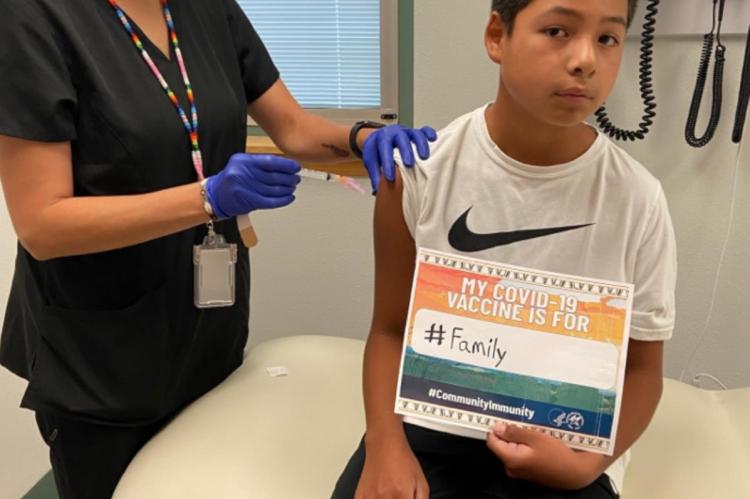
The use of the Pfizer COVID-19 vaccine for the prevention of COVID-19 now includes adolescents 12 through 15 years of age. Vaccinating adolescents means students can return to social and school activities which is what brought 12-year-old Avery Medicine Bear in to IHS as he received his first COVID-19 vaccine Thursday morning. With his grandma living with them in their home, his mother encouraged him to get the shot. He wants to live a normal life when school resumes this fall, and he travels a lot with his love of basketball. Medicine Bear shared he only knows of one other person his age who has been vaccinated. Avery’s father, Harry Medicine Bear, shared he encouraged his son to get his vaccine as he had concern with his son’s young age on how the virus may effect him long-term.
With his immunization, Medicine Bear joins the 71.3% of the 3,668 residents in the Wagner area who are inoculated for the virus, according to IHS. This includes Native and non-Native residents who have received their vaccinations at IHS and other local medical institutions such as Bubak Medical Clinic and Wagner Community Memorial Hospital-Avera.
Robert Flying Hawk, Yankton Sioux tribal chairman, shared of his symptoms of COVID and urges tribal members to get vaccinated.
Willard Bruguier, Sr., and his mother, Myrtle Bruguier were among those present to share the importance of getting the COVID vaccine. They shared they have seen the impact of the virus, as they lost a loved one due to COVID. They both said they now feel relieved as they have taken steps to protect themselves and others against COVID.
In a community effort to treat the pandemic, IHS opened their doors to testing anyone. The site has administered tests to over 15,000 people that came from as far west as Winner.
Mel Otte, Wagner IHS infection control officer shared the highest rates of cases were in November and December with over 500 positive cases in one month. With the large elderly population of the Yankton Sioux Tribe and the high rate of diabetes and other underlying conditions, COVID was a serious threat and they had to work with the schools, businesses and local medical facilities to keep the residents safe with the state not shutting down. Their concern now is the unknown regarding the variants, wanting to be prepared. They will focus on watching the future projections of the CDC. “The fight isn’t over, we are just changing our target age groups,” she added, “as the age group not vaccinated right now are our caregivers typically.”
IHS is looking into new strategies to reach those age groups as the long term effects of COVID is three to four percent higher for long term effects for tribal members.