

South Dakota in 20 Artifacts
South Dakota in 20 Artifacts
I’ve always loved South Dakota history, especially when I can see or interact with tangible objects that were part of significant events or belonged to culturally important people. I knew I couldn’t be alone in that affinity, so I asked Ben Jones, our state historian and director of the South Dakota State Historical Society. He mentioned a recent American Historical Association study that found people prefer to visit museums and historical sites — where they can interact with historical objects — rather than read history books. “The draw is that they want to see the real, tangible thing,” he said.
It turns out that’s easy to do in South Dakota. We found 20 such objects in museums and other public buildings that people can see and are related to pivotal moments in our state’s history. An article featuring all of them appeared in our July/August issue, but here is a sample of our discoveries.
Last year, I wrote a story about the legacy of Jack McCall in Yankton. McCall stood trial and was executed in Yankton for killing Wild Bill Hickok in Deadwood’s Saloon No. 10 in 1876. A historical plaque marks the spot where the gallows stood on the north end of town, and the jail that housed him is now an apartment building. But I was surprised to learn that a set of shackles that McCall wore during his Yankton confinement can be seen at the Pettigrew Museum in Sioux Falls.
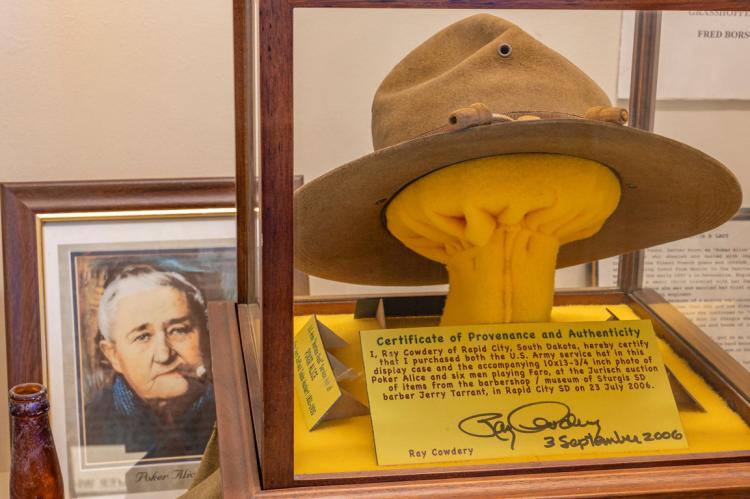
On a trip to the Black Hills, I stumbled upon Poker Alice’s Army hat in the Fort Meade Museum in Sturgis. One of the most iconic images of the West is the photo of Poker Alice, dealing a game of faro during Deadwood’s Days of ‘76 with that hat firmly on her head. It came to the museum courtesy of Ray Cowdery of Rapid City, who bought it at auction in 2006.
Baseball fans have likely heard the story of Bill Prunty’s dramatic home run to end the 1938 state amateur tournament. Aberdeen and Claremont were tied 4-4 heading into the bottom of the 10th inning. Darkness was quickly descending over the ballpark in Aberdeen, and umpire Tommy Collins was on the verge of suspending the game until the next day. There were two outs when Claremont’s Bill Prunty stepped to the plate.
“Can you see the ball?” he asked Collins as he dug into the batter’s box.
“Yes, I can,” Collins replied, “but you be careful. It’s getting pretty dark.”
Prunty worked the count to 3-2, fouling off five consecutive pitches. He remembers Collins telling him there would be just one more pitch. “So naturally I was swinging hard,” Prunty recalled. “I just met a high, outside pitch and out of the park it went. It was the biggest thrill of my life.”
The crowd of 4,000 fans spilled onto the field. Collins escorted Prunty around the bases to be sure he touched each bag. The next day, someone found the ball lying in the grass beyond the right field wall. It is now on display at the South Dakota Amateur Baseball Hall of Fame in Lake Norden.
I grew up in Lake Norden, just three blocks from Prunty’s home run ball. Maybe I’ve always known that tangible reminders of our history are right around the corner in South Dakota.
John Andrews is the editor of South Dakota Magazine, a bi-monthly publication that explores the people and places of our great state. For more information, visit www.southdakotamagazine. com.