

THE MOST DANGEROUS GAME
THE MOST DANGEROUS GAME
Roger Wiltz
Rog's Rod & Nimrod
Over the years, I’ve read volumes on the subject of dangerous game. It’s not necessarily about things that bite. Cow elephant hunts are often mentioned, but the guy who gets the most press is the African Cape buffalo. Given the chance, he’ll charge, and he’ll stomp on you until you’re nothing but a big greasy spot of mud.
My good friend, Mitchell, SD hunter Paul Muth, began his ten day Mozambique Cape buffalo hunt on October 2, 2019. It was springtime in Africa, and the daytime temperatures exceeded 100 degrees F. If he had it to do over, he would have gone in July when the winter temperatures would have been in the 80’s. They walked 8-9 miles a day, an exercise that taxed Paul to the max.
The four day trip to hunting camp began with a flight from Sioux Falls to Atlanta. The flight from Atlanta to Johannesburg, South Africa was followed by a short flight to Phalaborwa, Limpopo, South Africa’s northernmost province. From there it was 12 hours in a Toyota Land Cruiser over sometimes rough dirt trails.
Paul hunted from dark to dark, beginning at 4:30 a.m. and ending at 7:00 p.m. The five man crew included Paul, two PH’s or professional hunters, and two trackers. Paul’s outfitter, Albert Alberts of Alberts Lowveld Safaris, had been recommended to him by a friend who had made 22 safaris with Alberts. The Alberts camp also employed ten anti-poachers and a number of cooks, housekeepers, and skinners.
The Alberts hunting concession included 70,000 acres of unfenced Mozambique veld. A day’s hunt would typically begin in the Land Cruiser with the trackers looking for buffalo tracks that crossed the road. By towing a small tree that obliterated older tracks, they knew if tracks were fresh. The trackers were experts in determining whether or not a track was worth following on foot, and many stalks ended in frustration when the buffalo detected human scent because of a change in wind direction. It usually took 5-6 hours to get on the buffalo, and heavy thorn brush often limited visibility to small openings.
The game plan was to put a respectable bull on the ground, and then spend the remainder of the hunt looking for a superior bull if time permitted. Other game animals were often sighted, but Paul remained focused on buffalo. He did take an exceptional wart hog at hunt’s end.
Paul carried a bolt-action rifle in the .375 H&H Magnum caliber…..the minimum round permitted for hunting African Cape buffalo. His bullets were 300 grain soft points. The PH’s carried heavier guns for backup work. When I asked Paul if they had seen any elephants, he asked me if I had seen any cows on my way to Mitchell.
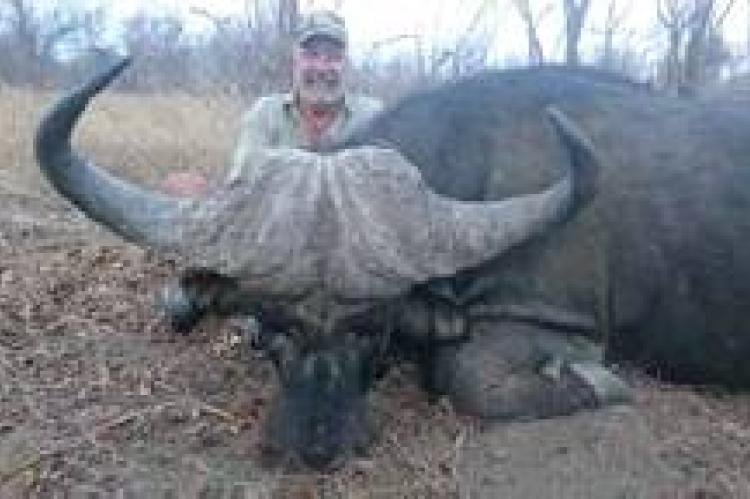
The first buff came on day seven with a 28 yard shot from a kneeling off-hand position. Paul anchored the excellent bull with follow-up shots, and no backup shots were fired by either PH. It was a very old bull with 36 inch horns and a deep curl. Though well satisfied, Paul had three days to find an even better trophy – a tough assignment at best.
An even better bull provided a life-threatening confrontation on day nine. In spite of Paul’s well-placed shot over shooting sticks, the bull didn’t go down. Fortunately the bull didn’t immediately detect the source of the shot, but he did after Paul’s errant second shot hit him in the foot. The bull now went into a full charge and took Paul’s third shot into the brisket at 25 yards. That shot turned him, and Paul was able to put him down with a fourth shot. His fifth shot was followed by the bull’s loud, ominous death bellow. The big guy’s horns measured better than 42 inches from tip to tip.
When Paul asked the PH’s how long they would have waited for him to fire during the charge, they replied it would have come in another second.
The Land Rovers were equipped to load the bulls whole without field dressing, and no meat, not even the intestines, were wasted. As you read this, Paul’s three trophies are being processed in Africa as shoulder mounts. Africa’s renewable resource hunting industry provides many jobs as well as feeding lots of hungry people. Will Paul go back? He’s already thinking crocodile, honey badger, and another cape buffalo.
See you next week.