

BON HOMME AND AVON STUDENTS MOVE THEIR CLASSROOM TO THE OUTDOORS AT THE WALKES FARM
BON HOMME AND AVON STUDENTS MOVE THEIR CLASSROOM TO THE OUTDOORS AT THE WALKES FARM
Mary Walkes
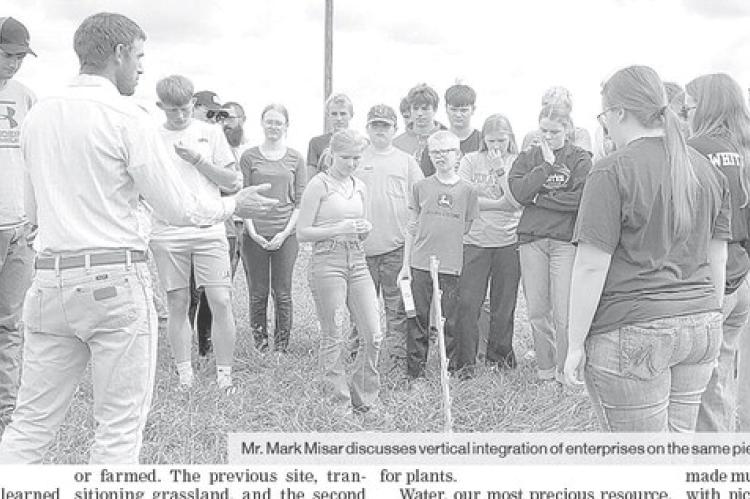
“Everything we saw and learned today - the bees depend on all of it. And we depend on them.” Missy Johnson, The Mindful Hive. The first stop of our roving classroom was a grass restoration site. Mr. Mark Misar discussed the merits of using as much solar energy as possible with different types of plants; some are tall, some creep on the ground and others bunch and have rhizomes to reproduce. He pointed out the merits of stacking enterprises to enhance the productivity of the land; cattle grazing together with sheep, followed by chickens. During the month of May, 49 pairs of cattle and one bull made one pass through the pasture moving almost daily in temporary paddocks. This group grazed only the tops of the growing grass, then left in June. Thus, the grass remained vegetative, just as mowing the lawn keeps the grass from going to seed. After a 30 day pause in grazing, the grass was green and lush for 20 pairs of cattle and 235 ewes that arrived in July and left in August. Chickens are the clean up crew. After dung beetles bury manure so plants have better access to the nutrients, the chickens then scrape through it for tender fly larva and spread it out to better allow the grass to grow through it. The students viewed a frozen specimen that told the ‘Tale of Two Livers’. One liver was from an organic chicken. The other was from a similarly aged chicken that had been fed commercial feed. The comparison made it real to those in attendance that “We are what we eat!” The second site has never been tilled or farmed. The previous site, transitioning grassland, and the second site, native pasture with overgrowth of smooth bromegrass are examples of management striving to return the land to a state of natural balance. Although Bromegrass tolerates drought well, native grasses have deeper roots and are a better source of nutrition for the animals. If allowed to return to its original state of balance, the productivity of the pasture will be enhanced. That state of balance holds remnants of the past native species with the power to thrive, provide and heal; It is self sustaining. Shane Deranleau led the students on a walking tour of 15 plant species including grasses, forbs and shrubs. Traditional people used these plants for sustenance and healing: Echinesia for an anesthetic, Foxglove for heart problems, Grasses like little Bluestem for moccasin linings. Jen Fischer brought stuffed animals to depict underground microscopic workers. The students engaged in a skit showing the beneficial relationships between the microscopic underground workers and the plants. Sugars (homedried apples) were distributed to the skit participants representing plant roots and organisms sharing sugars (and water) with the diverse roots in a grassland ecosystem. The connection making this possible is the mycorrhizal fungi network. It serves to provide all the plants with the water and nutrients needed. These amazing networks can be miles in length if allowed to ‘do their thing’ undisturbed. Tillage, synthetic fertilizers and pesticides thwart this system, interrupting Nature’s lifeline for plants. Water, our most precious resource, can be saved underground; the amount of which depends on the organic matter present in the soil. The higher the amount of organic matter in the soil, the more water it can store. Every one percent of organic matter per acre can hold 20,000 gallons of water. For example, by increasing the amount of organic matter from 1% to 2%, an additional 20,000 gallons of water can be stored per acre. Roots have a “house” in the ground made by the underground workers such as earthworms, bacteria, actinomycetes, protozoa and nematodes. The value of the underground workers was demonstrated by comparing water infiltration near a water tank where the ground was compacted and no plants were growing. The water in that infiltration ring just did not infiltrate. The same amount of water in a ring nearby that had grass growing in it allowed the water to infiltrate in a few minutes. As always, the rainfall simulator provided a picturesque demonstration of how land management allows us to use and store the rainfall Mother Nature provides. It has always seemed to me that tilling my garden just before it rained would help it soak up the rain. This year, Mr. Misar “tilled” the black dirt that had no vegetation growing on it prior to turning on the “rain”. This did NOT improve the infiltration of the water through the black dirt - It repelled the water. When the tray was turned over, there was dry dirt one inch below the surface after an inch of simulated rain. The ride on the trailer was made much more comfortable and safe with picnic tables from Schuurmans Farm Supply. Delicious watermelon was compliments of Ken Eben of Ken’s “Garden of Eben.” Buttery popcorn made with coconut oil and salted with sea salt was prepared by the Labrake gals: Bri, Neveah and Gracie. Shane Deranleau, worked for eight years as a plant-cow-fire specialist and for the past ten years has been working as a water quality specialist with South Central Watershed Project. Jen Fischer has promoted regenerative farming in her previous employment with NRCS, now represented the Commercial State Bank of Wagner as a loan officer for ag and consumer lending.