

‘Lucky Lindy’ Visits South Dakota
‘Lucky Lindy’ Visits South Dakota
“A President of the United States, the most adored movie star in filmdom, Babe Ruth, Jack Dempsey – all gathered here together could not have attracted half the crowd nor a millionth of the cheering that greeted Colonel Charles A. Lindbergh in South Dakota today,” stated an article in the Sioux Falls Daily Argus-Leader on Saturday, Aug. 27, 1927.
An estimated 30,000 people packed together on an airfield near Renner to see the aviation legend and his airplane, the “Spirit of St. Louis.” Lindbergh had left Fargo, ND, that morning. En route to Sioux Falls, he circled Aberdeen, Redfield, Huron and Mitchell, allowing people in those communities a glimpse of the famous plane. A canvas bag containing a message from Lindbergh was dropped from the plane in each community, expressing regret for not having the time to stop and encouraging public support for continued air mail service and the construction of airports.
The “Spirit Of St. Louis” landed at the Renner field precisely at noon as scheduled.
After a five-minute meeting with the reception committee, Lindbergh was driven around the fenced-off landing strip in a convertible, much to the delight of the crowd.
Lindbergh’s speech during the 30-minute program promoted commercial aviation throughout
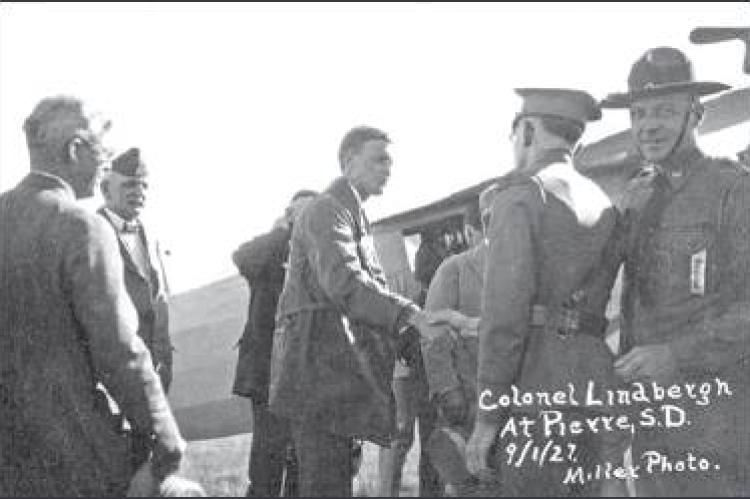
Charles Lindbergh visited South Dakota in 1927. Lindbergh flew into history with his successful non-stop flight across the Atlantic Ocean on May 20-21, 1927. The photos are of Lindbergh and the “Spirit Of St. Louis” while in Pierre. The text of the message Lindbergh dropped over each community read, “Greetings: Because of the limited time and the extensive itinerary of the tour of the United States now in progress to encourage popular interest in aeronautics it is impossible for the ‘Spirit Of St. Louis’ to land in your city. This message from the air, however, is sent to you to express our sincere appreciation of your interest in the tour and the promotion and expansion of commercial aeronautics in the United States. We feel that we will be amply repaid for all our efforts if each and every citizen in the United States cherishes an interest in flying and gives his earnest support to the air mail service and the establishment of airports and similar facilities. The concerted efforts of the citizens of the United States in this direction will result in America’s taking its rightful place within a short time as the world leader in commercial flying.” (Signed) Charles A. Lindbergh South Dakota State Historical Society – State Archives Photo the United States.
Lindbergh’s non-stop flight from New York to Paris over the Atlantic Ocean on May 20-21, 1927, had rocketed him to stardom. Lindbergh departed from New York in the “Spirit Of St. Louis” on a nationwide tour of the United States on July 20, 1927. The tour was the result of a meeting between Lindbergh and multimillionaire and aviation enthusiast, Harry Guggenheim. They decided Lindbergh would make a three-month tour of the United States, paid for by a fund Harry and his father, Daniel, had established earlier to encourage aviation-related research.
Lindbergh and the “Spirit Of St. Louis,” together called “We,” were accompanied on the tour by a plane carrying a representative of the Daniel Guggenheim Fund of the Promotion of Aeronautics and the United States Department of Commerce.
From Renner, Lindbergh flew off in the “Spirit Of St. Louis” at 1 p.m. to Sioux City, Iowa, where he spent the night.
Sept. 1 was intended to be a day of rest in Denver, CO, for Lindbergh. Instead, Harry Guggenheim sent a telegram to Pierre Mayor John E. Hipple stating that Lindbergh had “expressed a personal desire to spend the day of September first in your city. Can you arrange to take care of his time.” Hipple consulted with others before accepting the request.
Pierre had no airfield where Lindbergh could land, according to “Pierre Since 1910” by Harold Schuler. A landing site was prepared about three miles north of Pierre, on the south slope of Snake Butte.
About 3,500 people were on hand when the “Spirit Of St. Louis” touched down at 3:59 p.m. on Sept. 1, one minute ahead of schedule. The Capital City Band played and cheers went up as Lucky Lindy stepped out of the plane. After a drive around the airfield, the car bearing Lindbergh headed to Pierre for a drive through the city’s main streets. Hipple and his wife, Ruth, hosted a supper for Lindbergh and other guests at their home.
About 5,000 people were waiting in front of the Capitol that evening to hear Lindbergh speak. He explained he decided to come to Pierre because he wished to give people in that part of the country the opportunity to see the plane that flew across the Atlantic Ocean.
Lindbergh briefly attended a dance in the city auditorium before returning to the Hipple home to thank the Hipples for their hospitality. He then went to the Saint Charles Hotel to retire for the evening.
Several hundred people were on hand the next morning to witness the 9:30 departure of the “Spirit Of St. Louis” for Cheyenne, WY, where Lindberg would spend the night.
“Once in the air, Colonel Lindbergh banked his plane sharply and returned to give a short display of stunt flying . . . Suddenly, the silver ‘Spirit Of St. Louis’ headed toward Pierre to give a farewell greeting to the people here,” stated an article in the Sept. 2, 1927, Pierre Daily Capital Journal.
En route to Cheyenne, the “Spirit Of St. Louis” flew over Philip, the State Game Lodge in the Black Hills where President Calvin Coolidge was spending the summer, Rapid City, Spearfish and Deadwood. The “Spirit Of St. Louis” did not fly over Lead but the plane could be seen from the Ellison dumps, according to the Lead Daily Call. Messages from Lindbergh were dropped in communities.
Historical markers both at Renner and Pierre commemorate Lindbergh’s visit to South Dakota.
Flying the “Spirit Of St. Louis,” Lindbergh touched down in what at that time was all 48 states, visited 92 cities, gave 147 speeches and was seen by millions before the tour ended back in New York on Oct. 23, 1927, according to the website about Lindbergh operated by the Spirit Of St. Louis 2 Project.
Air mail usage exploded as a result of the tour and the public began to view airplanes as a viable means of travel, according to Air Force historian, Richard P. Hal-lion.
This moment in South Dakota history is provided by the South Dakota Historical Society Foundation, the non-profit fund-raising partner of the South Dakota State Historical Society at the Cultural Heritage Center in Pierre. Persons may find them on the web at www.sdhsf.org or contact them at info@sdhsf.org to submit a story idea.